
By Tristan · Arts, exhibitions and creative culture
This is an opinion piece. Views expressed are the author's own and do not constitute professional advice.
The archive that could not be burnt.
This Enemies and Rascals review covers Terence Gower's sound installation for Artangel, running until 18 October 2026 inside a sealed Victorian strongroom at the Maughan Library. Entry is free, sessions run forty minutes.
Cool Factor: 3/5

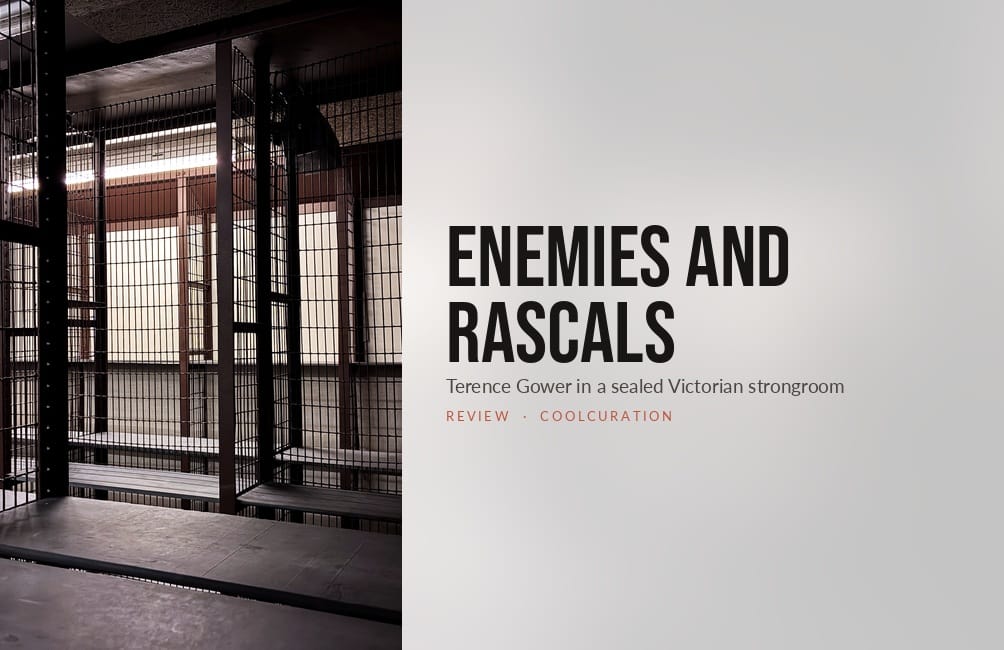
The Original Cell, emptied of the records it was built to protect.
There is a black iron door on the ground floor of the Maughan Library marked "Pull to Enter". Behind it sits a room that has been locked for most of its life. Consequently, the first thing this piece does is to let you in.
Section 01 / What it is
What is Enemies and Rascals?
Three years in the archives, turned into voices you stand inside.
Terence Gower is a Canadian artist who lives between New York, Mexico City and France, and who has built a research-driven practice out of archives and architecture. A Guggenheim Fellowship in 2010 pushed him towards Cold War geopolitics, and since then he has staged interventions inside Philip Johnson's Glass House and Mies van der Rohe's Barcelona Pavilion, both using sound and space to test how a building can resonate with people. The Power Plant in Toronto gave him a survey, Embassy, in 2024.
For this Artangel commission he spent three years tracing a largely forgotten episode: the American invasion of Quebec in 1775 and 1776, the first large-scale military operation of the War of Independence. He worked across The National Archives at Kew, the New York Public Library and King's College London's own Foyle Special Collections Library.
His explanation of why he came here is disarmingly simple. "I wanted to tell the story of Canada's early history with the United States, and I came to Britain to find it," he writes in the accompanying booklet. "In archives in London I discovered the cries for help sent to London headquarters by the besieged British governor of Canada." The result, he says, "is therefore a site-specific installation in London but about another place, 5,000 kilometres away."
Section 02 / The room
The Original Cell does half the work
London's first purpose-built fireproof building.
The Maughan Library began life in 1851 as the Public Record Office, and it was London's first purpose-built fireproof structure. Colonial correspondence, previously scattered across Whitehall, was moved here in the 1850s and stayed until the 1990s, when the records went out to Kew. The building earned a nickname that Gower leans on hard: the strongbox of empire.
Here is the detail that makes the commission click. Much of the bound material that did not go to Kew ended up in the Foreign, Commonwealth and Development Office library, and a large part of that was transferred to the Foyle Special Collections Library at King's in 2007. Many of the documents underpinning Enemies and Rascals are therefore still in this building, a few floors from where you are standing.

Iron stacks and the mezzanine walkway, built so that nothing in the room could burn.
The cell itself is stranger than a room. After passing through corridors and a great number of modern fire doors, apt for the building, you enter a darkened space with herringbone parquet flooring and iron stacks rising either side, with a mezzanine metal floor above accessed by a switchback iron staircase to your left. Slate shelves run away into the dark, chosen because slate does not burn. Every part of this building was considered by its Victorian designers. Beyond the shelves is an octagonal space, its windows all covered, with seating. A few strip lights illuminate the room; the rest is in shadow.
We are in an archive storage room, but the shelves are empty. Where did the archive go?
Terence Gower
Section 03 / The session
Forty minutes, on the hour and the quarter
Firstly, know that sessions are timed. Fixed start times are posted beside the door, and booking is recommended though not essential. This is not a room you drift into for five minutes. You commit, or you come back.
My first thought inside was that Gower had barely intervened. There is nothing to look at. No screen, no vitrine, no wall text. Just iron, slate and the sound of different actors reading the words of historical figures, the latter emanating from speakers dotted around the space. Afterwards, though, the restraint reads as the argument itself. Everything you hear was written down, filed and stored somewhere exactly like this, and the emptiness is what an archive looks like once its contents have gone to Kew.

Room G.38, with the session times pinned up beside the handrail.
It was also a monastic experience, with no sense of time from the outside world and the words of people long dead washing over me in the space. A few people drifted in and out, but mostly I had the space to myself and my friend Denise, who had joined me for the visit.
Section 04 / The voices
Who gets to speak
Take the printed booklet on the way in, because it carries the character list and the list is the work's real skeleton. Twenty-four voices, given in order of appearance.
It opens with a Narrator, described as "our guide to the archive", then Sir William Johnson, the Crown's superintendent of Indian relations in the northern colonies from 1756 to 1774. After that the famous names of white men arrive in a steady procession: the Second Continental Congress, John Adams, Philip Schuyler, King George III, George Washington, Benjamin Franklin, Richard Montgomery, Guy Carleton, Benedict Arnold, Thomas Jefferson.
What makes the piece worth an hour of your life is who Gower puts beside them.

The booklet and its character card, which is where the Enemies and Rascals review really begins.
There is Caesar Sarter, an African-born abolitionist writing in Massachusetts, author of a 1774 essay on slavery in The Essex Journal drawn from his own twenty years of enslavement in the Thirteen Colonies. There is Killbuck, speaking for a deputation of several nations living along the Ohio River, including the Delawares, Munsees and Mohicans. There is an unnamed sachem, spokesperson for a delegation logged in the record only as "the deputies of the Indians", meeting Guy Carleton at the great church of Montreal. There is Jean-Baptiste Badeaux, a notary at Trois-Rivières, and Jacob Danford, an artillery officer in the Canadian militia, and an anonymous officer in the Continental Army who survives solely as a letter in Peter Force's American Archives.
And there are the "sachems, warriors, and female governesses of the Oneida Nation", a member nation of the Haudenosaunee Confederacy.
Notice the phrasing in the list, though: for the sachem, for Killbuck, and for the Oneida, the entry ends "speech transcript read by the narrator". These voices do not get their own actor. That is a defensible choice, since what survives is a colonial transcription rather than the speech itself, and Gower is explicit that the transcribers were partisans. Nevertheless, it means the piece reproduces the very hierarchy it is describing. Kings get a voice. Sachems get a narrator.
Section 05 / The idea
The best idea in the work
Buried in Gower's booklet essay is the passage that reframes everything.
He describes how colonial observers recorded the way First Nations preserved treaty negotiations. Male chiefs spoke, sat facing the colonial negotiators, within a semicircle of women, who were in turn surrounded by their children. The women memorised what was said and passed it to the next generation, who passed it to theirs. Gower calls it a memory-archive, and then delivers the line the whole commission turns on: "It can't be burnt, nor can it be eaten away by mould or damp."
He footnotes Benjamin Franklin, present at a meeting in 1774, as quoted by the historian Bruce Johansen: "Women ... are the Records of the Council."
Set that against the room you are standing in. Britain spent a fortune on slate and iron to protect paper from fire, a few decades after the events of a war they lost. Meanwhile a rival archive, unburnable and unstealable, was being maintained by women who appear in the colonial record only as an unnamed semicircle.
Section 06 / The title
Where the title comes from
Gower saves the explanation for the end of his essay, and it is a good one.
When the Continental Army crossed into Quebec and occupied Montreal, the Connecticut general David Wooster was appointed governor of the city. He was older than Montgomery and thoroughly unpopular. He retaliated against the Catholic Church by selectively forbidding masses, and imposed taxes on Montrealers to cover the costs of their own occupation. Eventually, at a meeting with petitioners who had requested a hearing, he lost his composure entirely and screamed: "I regard the whole of you as Enemies and Rascals!"
The line survives in the journal of Simon Sanguinet, published in Montreal in 1873. It is the sound of a liberator discovering that the liberated are not grateful, and Gower is right that it does not feel remotely like the eighteenth century.
Section 07 / The archive
Hazards of the archive
The other strand running through the piece is how nearly all of this was lost.
Correspondence crossed the Atlantic by sail, held up for weeks by wind, or by a governor finishing his letters, or by a treaty transcript still travelling east from the frontier. Sometimes the ship sank. Gower quotes General Haldimand writing to Carleton from Quebec in June 1782 about a letter that "shared the fate of others in the Bellona, which after a fortunate passage to the South Traverse, there struck upon a rock and went down".
Then there is deliberate destruction. Guy Carleton, the British governor, had a policy of burning rebel correspondence without reading it. He burned Richard Montgomery's capitulation letter, and a manuscript copy survives in Belfast only because a Northern Irish officer, Captain John Maxwell, took the abandoned rebel papers as personal property after the siege broke. At the end of his life Carleton burned his own correspondence too, depriving every future researcher of his motives.
Carleton is also the source of the sharpest line in the piece. Berating the invading Continental Army, he asks: "Why did you come to disturb an honest man and his government, that never did you any harm in his life?" Gower then invites you to imagine the same sentence spoken by the Marquis de Vaudreuil as Wolfe surrounds Quebec in 1759, and then by the Saint Lawrence Iroquois to Samuel de Champlain in 1608. The question travels backwards indefinitely, and nobody ever answers it.
He calls his method "wild scholarship": appropriation plus the necessary interrogation of history writing. It is a good phrase and an honest one, since he is upfront that he is not a historian.
Section 08 / The finale
When everybody talks at once
The piece builds to a passage where the separation collapses. Voices that have taken turns for almost forty minutes begin to overlap, then pile up, until the room is a wall of eighteenth-century argument arriving from every direction.

Someone leaving by the iron staircase, halfway through the forty minutes.
Arguably that is the point. Empire is noise, and the archive is what survives the shouting. Even so, I wanted to catch more of it than I did. It reaches a crescendo of voices for about a minute, then they all cease, giving way soon after to birdsong and time for reflection on what we have just heard.
Section 09 / The Weston Room
The Quebec Act display in the Weston Room

Nine cases in a single row, under the Rolls Chapel glass and the iron chandeliers.
Along the corridor, via a few more of those fire doors, is the companion exhibition, The Quebec Act, drawn from the Foyle Special Collections Library and curated by Gower with Katie Sambrook and John Wilby. The Weston Room is a reconstruction of the old Rolls Chapel and it is genuinely beautiful: armorial stained glass, iron chandeliers, deep terracotta walls and a few Tudor and Stuart tombs reinserted here in the 19th century.
The display is the weakest part of the visit, not for the contents, more the excess of information to take in and the way in which it is displayed. Nine numbered sections run from the colonial archive at the Public Record Office through Nouvelle France, the Seven Years' War, North America's First Nations, the economics of colonisation, the writing and debating of the Act, the invasion, and the 1783 Treaty of Paris. It is an undergraduate module in one row of cases.
Consequently it reads like a capable regional museum display rather than the work of an artist who has just spent forty minutes proving he understands editing. The cases sit under the windows, the chandeliers throw warm light across the glass, and reading the smaller documents means angling yourself to dodge reflections. Conservation limits on eighteenth-century paper are non-negotiable, admittedly. Nevertheless, half the material and twice the space would have doubled the impact. The material is fascinating though: maps of the regions, facsimile letters from George Washington and others. It is just hard to fully take it in due to the display constraints.

Case 1.3: the repositories photographed in the 1950s, while the rolls were still on the shelves.
There is a Torrigiano in the room
The Weston Room preserves part of the Rolls Chapel, on a site given over to the Domus Conversorum by Henry III in 1232 and rebuilt by Inigo Jones in 1617. It holds the terracotta monument to Dr John Yonge, Master of the Rolls, who died in 1516. The sculptor was Pietro Torrigiano, the Florentine who made the tomb of Henry VII in Westminster Abbey and the painted bust of the king now in the V&A. It is often called the earliest Renaissance monument in England, and it is free to stand in front of.
If you have seen that bust on a V&A visit, the modelling of the face gives the game away at once. Two works by the same hand, five hundred years old, twenty-five minutes apart on foot.
Section 10 / Criticism
Honest critical observations
Firstly, the work gives you very little help inside the room. There is no visible transcript, no indication of who is speaking, and no way to check. The booklet carries the character list, but reading it in that light is a struggle, and looking down at a booklet is the opposite of what the space wants you to do.
Secondly, the credits deserve a mention. Seven actors are listed: Matt Addis, Jack Ambrose, Nicholas Boulton, Olivier Huband, Harry Myers, Nigel Pilkington and Sian Thomas. That is one woman. In a work whose best insight is that Indigenous women were the archive, a single female voice is a conspicuous shortfall, and it compounds the decision to route the sachem, Killbuck and the Oneida through the narrator rather than giving them their own performers.
Thirdly, the overlapping climax sacrifices the detail that justifies the project. That is a real trade, not an imagined one.
Fourthly, forty standing minutes in a cold iron room is a genuine ask and the seating is improvised at best.
Finally, the two halves of the commission do not speak to each other. The Original Cell is ruthless. The Weston Room is generous to the point of clutter. One artist shaped both.
None of that is fatal. All of it is why this is a three out of five show.
Section 11 / Context
Why this Enemies and Rascals review matters now
Artangel have spent over thirty years putting art into buildings that are not galleries, and this sits squarely in that lineage alongside work by Jeremy Deller, Roger Hiorns, Michael Landy, Steve McQueen and Rachel Whiteread. Support comes from Arts Council England, the Terence Gower Exhibition Circle, the Beaverbrook Canadian Foundation and the High Commission of Canada in the UK, with King's College London as presentation partner. A Canadian story, told deliberately in the building where Britain filed the receipts.
Gower does not pretend the timing is accidental. "The work arrives at a moment when the rhetoric surrounding this 18th century conflict ... resonates with unsettling familiarity today," he writes, and his own bibliography includes a Guardian piece from January 2026 on the revival of American designs on Canada. He means liberation offered at gunpoint. The eighteenth-century language, delivered flat and uncommented, therefore does more work than any wall panel could.
If the archival rigour of the Christine Kozlov show at Raven Row appealed to you, this operates on similar ground with considerably more force.
Section 12 / Practical
Is it worth your time?
It costs nothing, so the only outlay is the journey and the forty minutes. Comparable sound commissions in London charge fifteen to twenty pounds, and none of them come with a sealed Victorian strongroom attached.
Book ahead anyway, because sessions are timed and the cell holds few people. It also pairs well with Sir John Soane's Museum and the Inns of Court, both within a ten-minute walk. If you are travelling in for the day, our Railcard discount guide is worth a glance first.

The Chancery Lane entrance. The Original Cell is on the ground floor, past the fire doors.
Practical information
- What: Enemies and Rascals by Terence Gower, commissioned and produced by Artangel, presented with King's College London
- Where: The Original Cell (room G.38), Maughan Library, King's College London, Chancery Lane, London WC2A 1LR
- When: Friday 3 July to Sunday 18 October 2026
- Hours: Wednesday to Friday, 12:00 to 19:00. Saturday and Sunday, 11:00 to 17:00. Closed Monday and Tuesday.
- Running time: 40 minutes. Wed to Fri starts: 12:15, 13:00, 13:45, 14:30, 15:15, 16:00, 16:45, 17:30, 18:15. Sat and Sun starts: 11:00, 11:45, 12:30, 13:15, 14:00, 14:45, 15:30, 16:15.
- Price: Free. Booking recommended but not essential.
- Access: Wheelchair access to the Original Cell is not advised, since entry is onto a raised metal walkway with an iron staircase. Step-free access to the Weston Room display via the access lift. Large print transcripts available.
- Credits: Sound design by Call & Response Studios. Recording engineers Angus Cattapan and Rónan Murphy at Noatune Studios. Script development by Merle Nygate. Audio director Tamsin Collison.
- Nearest tube: Chancery Lane and Temple
Book free tickets via Artangel
Section 13 / Verdict
The verdict
Cool Factor
★★★☆☆
3 out of 5, Cool
The Enemies and Rascals review verdict in one line: worth the trip for the room and the central idea.
Go for the room, stay for the voices, and give yourself twenty extra minutes for the Torrigiano. It costs nothing, and the Original Cell is unlikely to open again soon, which is most of the argument for going.
Send this one to anyone interested in art or history, and in particular to anyone drawn to Black history, colonialism or Canada. Skip it if you struggle in smaller spaces or have mobility issues, because this is not a very accessible room.
Overall, a solid 3/5 Cool. Enemies and Rascals uses its setting well, and its central idea, that Britain built a fireproof building while its opponents built a fireproof memory, is worth the trip on its own. It falls short of Stone cold for two reasons. The overlapping finale dissolves precisely the detail that three years of archive work uncovered. And for a piece that recognises Indigenous women as the true archive, routing every Indigenous voice through a narrator, with one woman among seven actors, undercuts its own best argument. Fix that balance and it would climb. Even so, David Wooster's outburst has been waiting two hundred and fifty years for a room this good, and it has finally got one.
Enemies and Rascals FAQs
Is the Enemies and Rascals exhibition free?
Yes. Entry costs nothing and Artangel describe booking as recommended but not essential, although the Original Cell holds few people per session.
How long does Enemies and Rascals take?
The piece runs for forty minutes with fixed start times. Sessions begin at 12:15 on Wednesday to Friday and at 11:00 at weekends, so check the schedule before travelling.
Where does the title Enemies and Rascals come from?
From General David Wooster, the American governor of occupied Montreal, who lost his temper with a delegation of petitioners in 1776 and shouted, "I regard the whole of you as Enemies and Rascals."
Where is the Original Cell at the Maughan Library?
Room G.38, inside the former Public Record Office on Chancery Lane, London WC2A 1LR. The nearest tube stations are Chancery Lane and Temple.
Is Enemies and Rascals wheelchair accessible?
Artangel advise against wheelchair access to the Original Cell, because entry is onto a raised metal walkway served by an iron staircase. The Weston Room display is reachable step-free via the access lift, and large print transcripts are provided.
Is there anything else to see at the Maughan Library?
Yes. The Weston Room preserves part of the old Rolls Chapel, including Pietro Torrigiano's 1516 terracotta monument to Dr John Yonge, often called the earliest Renaissance monument in England.
When does Enemies and Rascals close?
Sunday 18 October 2026. The building opens Wednesday to Sunday only.
More from CoolCuration
If this Enemies and Rascals review has put you in the mood for a gallery day, start here.
- Whistler at Tate Britain review - another London show where the room matters as much as the pictures.
- The V&A LGBTQ tour review - a free volunteer-led hour that changes how you read the collection.
- Great Women Artists - the reference book to reach for when a show leaves women out of the credits.
- Howard Hodgkin, Indian Leaves print - what to hang once you have decided you like being in rooms like this.
- Gifts for artists and creatives - our running list, useful when a birthday lands mid-exhibition season.
- theprintspace discount code - for printing and framing your own work properly.
- Hospital Rooms poster sale - four £100 prints by Joffe, Paul, Perry and de Balincourt, sold to fund art in mental health wards.
- London Design Festival 2026 guide - twelve picks across three walks, and the one day when nine of the ten headline shows are open.
What's trending




Recent posts
- Premium Bonds Alternatives UK 2026: Prize Savings Accounts Compared
 Four Premium Bonds alternatives open to new savers, with each provider's published odds, prize tables, access rules and protection.
 - Best Audiobooks October 2026: 10 UK Listens RankedTen new audiobooks for October 2026, from a full-cast Dracula with Jonathan Bailey to Russell T Davies reading his own television memoir.
- Louis Fratino at David Zwirner ReviewLast updated: 4 October 2026 By Tristan · Arts, exhibitions and creative culture This is an opinion piece. Views expressed are the author's own and do not constitute professional advice. Exhibition reviewMayfair Saunas, subway cars and a lot of skin in Mayfair Louis Fratino at Zwirner is the American painter's first solo show in London,… Read more: Louis Fratino at David Zwirner Review


No Comments.