
Last updated: 29 March 2026
By Stiv · Design, technology and personal finance
This article contains affiliate or referral links. If you click through and sign up I may earn a commission or referral bonus at no extra cost to you. It does not affect my editorial view.
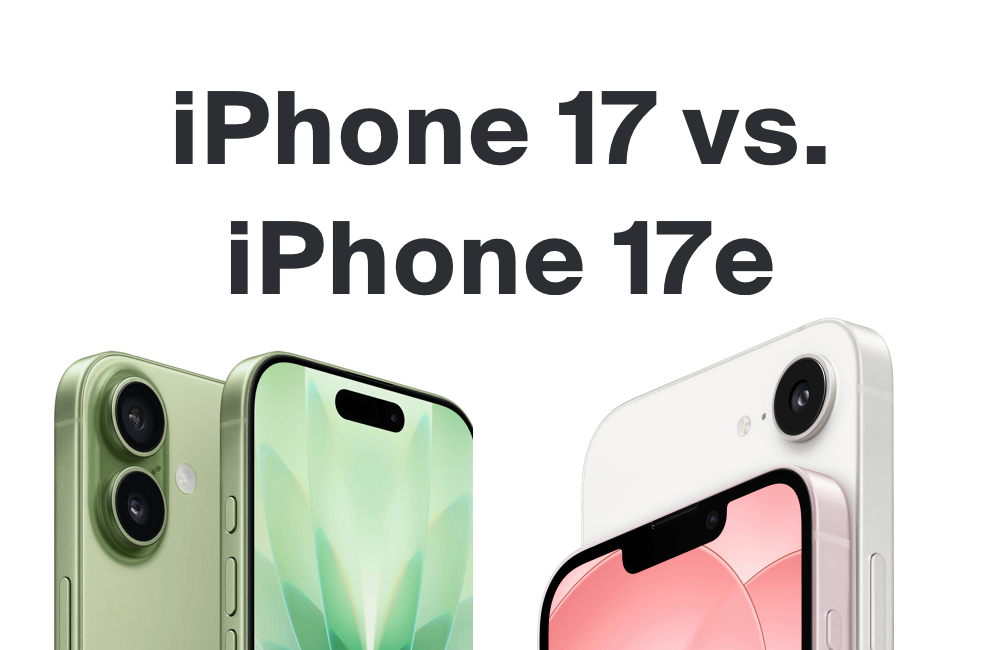
The iPhone 17 vs 17e decision is one most UK buyers are wrestling with right now. Apple's 17e landed on 11 March at £599, sitting a full £200 below the standard iPhone 17 at £799. Both run the same A19 chip and pack a 48MP main camera, so on paper they look remarkably similar. However, dig a little deeper and the differences start to matter. Whether you care about refresh rates, camera flexibility or simply getting the best value, this guide breaks down every key difference so you can decide with confidence.
Still choosing between models? My iPhone guides hub collects the lot, from the 16e comparison to refurbished deals and SIM plans.
iPhone 17 vs 17e: price and release date
The iPhone 17 starts at £799 for 256GB and has been available since 19 September 2025. Meanwhile, the iPhone 17e launched on 11 March 2026 at £599 for the same 256GB storage. It replaces the 16e as Apple's most affordable current-generation iPhone.
Notably, both phones offer a 512GB option too. The real headline here is that there's no 128GB tier on the 17e. Apple doubled the starting storage compared to the 16e without raising the price. As a result, the £200 gap between the 17 and 17e is purely about features, not storage upselling.
So what exactly are you giving up for that £200 saving?
Design and display
Physically, the two phones are closely related. Both have an aluminium frame, glass back, second-generation Ceramic Shield on the front, IP68 water resistance and an Action button. Even so, the differences are worth your attention.
Screen size and refresh rate
The iPhone 17 has a larger 6.3-inch display, compared with the 17e's 6.1-inch screen. More importantly, the iPhone 17 brings 120Hz ProMotion to the standard model for the first time. It also includes an always-on display. In contrast, the 17e sticks at 60Hz with no always-on functionality. Scrolling and animations feel noticeably smoother on the 17, although in casual day-to-day use you might not dwell on it.
Brightness and notch
Brightness is another notable gap. The iPhone 17 peaks at 3,000 nits outdoors, roughly 2.5 times brighter than the 17e's 1,200 nits peak. In the UK, this probably matters less than in sunnier climates. Still, it does make a visible difference on bright days.
On top of that, the iPhone 17 uses Apple's Dynamic Island, the interactive pill-shaped cutout for Live Activities and timers. By comparison, the 17e still has the older notch design inherited from the iPhone 14 era. That makes it the only current-generation iPhone without Dynamic Island.
Colour choices differ too. The 17e comes in Black, White and Soft Pink, while the iPhone 17 offers Lavender, Sage, Mist Blue, Black and White.
Cameras
Both phones share a 48MP Fusion main camera with Apple's 2x optical-quality crop zoom. For everyday photography at standard focal length, you won't sacrifice core image quality by choosing the 17e.
Rear cameras and stabilisation
However, the iPhone 17 adds a second rear lens: a 48MP ultra-wide. That extra camera opens up group shots, architecture, tight interiors and more creative compositions. The 17e simply doesn't have an ultra-wide lens, so that versatility isn't available.
Stabilisation is more advanced on the 17 as well, with sensor-shift OIS on the main camera versus standard OIS on the 17e. Additionally, the 17 supports Photographic Styles including the new Bright preset, plus Dual Capture for recording from multiple cameras at once. Neither feature is available on the 17e.
Front camera
Up front, the difference is even clearer. The iPhone 17 has an 18MP Centre Stage camera that automatically reframes you as you move. The 17e keeps a 12MP front camera without Centre Stage support. Therefore, if video calls or selfie quality matter to you, the 17 has a clear edge here.
Performance and battery
Both phones run Apple's A19 chip built on 3nm technology. The 17e uses a slightly trimmed version with four GPU cores instead of five. In everyday use, though, performance feels broadly similar. Apps launch instantly, multitasking is smooth, and Apple Intelligence features work fully on both.
Battery life and charging
Apple rates the iPhone 17 for up to 30 hours of video playback, compared with 26 hours on the 17e. That gap is partly thanks to the 17's LTPO display technology, which can drop as low as 1Hz to save power. The 17e's fixed 60Hz panel can't do this.
Charging is quicker on the iPhone 17 too. With a 40W adapter, the 17 reaches 50% in 20 minutes. The 17e takes around 30 minutes to hit 50% with a 20W adapter. Both support MagSafe wireless charging, though the 17 maxes out at 25W versus 15W on the 17e.
In real-world use, neither phone will leave you hunting for a charger before bedtime. Nevertheless, the 17's faster top-ups and longer rated battery life do add up over time.
Consider a refurbished iPhone instead
Before committing to either phone at full price, it's worth thinking about refurbished options. Platforms like Back Market can save you a serious chunk of cash, and they're better for the planet too.
Back Market grades its devices across four tiers: Premium, Excellent, Good and Fair. Each one is tested and certified. You'll often find previous-generation iPhones at prices that undercut even the 17e. If you don't need the absolute latest model, a refurbished iPhone 16 or 16 Pro from Back Market could be the smartest move of all. We've written a full Back Market review if you want the detail.
Check refurbished iPhone deals on Back MarketiPhone 17 vs 17e: so which should you buy?
The iPhone 17e gets a lot right. It delivers current-generation A19 performance, 256GB as standard, MagSafe support and a capable 48MP camera, all at £599. If you want modern Apple performance without stretching your budget, it's a genuinely smart choice.
The iPhone 17 earns its £799 price tag, though. The 120Hz ProMotion display, brighter screen, Dynamic Island and ultra-wide camera make it the better pick for anyone who cares about display smoothness, camera versatility and the fullest standard iPhone experience.
If you're upgrading from an older iPhone 16e specifically, our iPhone 16e vs 17e buyer's guide breaks down that upgrade path in detail. And if you're shopping for a tech lover, our gifts for technology lovers collection has plenty more ideas.
iPhone 17 vs 17e: quick comparison table
| iPhone 17 | iPhone 17e | |
|---|---|---|
| UK price (256GB) | £799 | £599 |
| Display | 6.3" OLED, 120Hz ProMotion, always-on | 6.1" OLED, 60Hz, no always-on |
| Chip | A19 (5-core GPU) | A19 (4-core GPU) |
| Rear cameras | 48MP main + 48MP ultra-wide | 48MP main only |
| Front camera | 18MP Centre Stage | 12MP |
| Cut-out | Dynamic Island | Notch |
| Battery (video playback) | Up to 30 hours | Up to 26 hours |
| Fast charge (50%) | 20 min (40W) | 30 min (20W) |
| MagSafe | 25W | 15W |
| Colours | Lavender, Sage, Mist Blue, Black, White | Black, White, Soft Pink |
iPhone 17 vs 17e: frequently asked questions
Is the iPhone 17e worth the £200 saving over the iPhone 17?
For most people, yes. If you primarily use your phone for calls, messaging, social media and casual photography, the 17e offers excellent value. The A19 chip performs almost identically in daily tasks, and 256GB of storage is generous at this price. You're mainly giving up the ultra-wide camera, 120Hz display and faster charging.
Does the iPhone 17e have 120Hz ProMotion?
No, it doesn't. The iPhone 17e uses a 60Hz display. Only the iPhone 17 and above get 120Hz ProMotion with always-on display support.
Can I save money by buying a refurbished iPhone instead?
Absolutely. Platforms like Back Market sell certified refurbished iPhones at lower prices. For example, a refurbished iPhone 16 Pro often costs less than a new 17e while offering features like a telephoto lens and ProMotion display. It's also the more sustainable option.
Does the iPhone 17e have Dynamic Island?
No, it doesn't. The 17e still uses the older notch design. As a result, the iPhone 17 is the entry point for Dynamic Island in Apple's current lineup.
Is the camera on the iPhone 17e good enough?
For most people, yes. The 48MP Fusion main camera produces excellent photos in good and low light. What you miss is the ultra-wide lens, Centre Stage front camera and some advanced features like Dual Capture. Even so, for everyday shooting, the 17e holds its own.
Which iPhone 17 model has better battery life?
The iPhone 17 lasts longer, rated at 30 hours of video playback versus 26 hours on the 17e. Its LTPO display can drop to 1Hz when idle, which helps conserve power despite the larger screen.
You might also like
- Best SIM-only deals UK — Find a great SIM plan to pair with your new iPhone and cut your monthly costs.
- Honest Mobile — A UK network that runs on renewable energy and plants trees with every plan.
- Native Union Anchor Cable 240W — A premium braided USB-C cable that charges fast and looks the part.
- Gifts for technology lovers — Browse our full collection of curated gifts for tech enthusiasts.
- Airtime Rewards — Earn cashback on your mobile spending with this free UK rewards app.
What's trending






Recent posts
- Best Audiobooks October 2026: 10 UK Listens Ranked
 Ten new audiobooks for October 2026, from a full-cast Dracula with Jonathan Bailey to Russell T Davies reading his own television memoir.
 - Louis Fratino at David Zwirner ReviewLast updated: 4 October 2026 By Tristan · Arts, exhibitions and creative culture This is an opinion piece. Views expressed are the author's own and do not constitute professional advice. Exhibition reviewMayfair Saunas, subway cars and a lot of skin in Mayfair Louis Fratino at Zwirner is the American painter's first solo show in London,… Read more: Louis Fratino at David Zwirner Review
- What Is a Sprive Boost? Seven Days, and What It Actually PaysA Sprive boost lifts your cashback rate for seven days, and it arrives on its own. What mine paid, and why Supercharge is a display toggle rather than extra cashback.


No Comments.