
Last updated: 30 April 2026
By Tristan · Arts, exhibitions and creative culture
This is an opinion piece. Views expressed are the author's own and do not constitute professional advice.
This article contains affiliate or referral links. If you click through and sign up I may earn a commission or referral bonus at no extra cost to you. It does not affect my editorial view.
Cool Factor
★★★★☆
4 out of 5 – Stone cold
The best reason to climb several flights of stairs on a weekday afternoon is the possibility of a genuine discovery. Ruba Nadar's first solo exhibition at Pipeline Contemporary is exactly that. Running until 23 May 2026, I Saw Myself Playing on The National Team is a debut that announces an artist with real conviction, curated by someone who, show by show, is becoming one of the more interesting voices on London's emerging art scene.
What is it?
This Ruba Nadar exhibition brings together new mixed-media paintings and collages at Pipeline Contemporary, 31 Windmill Street, London W1T 2JN. It is curated by Andrew Price as part of Pipeline's Visiting Curator Program, which regularly brings an external curatorial voice into the gallery's programme. Nadar, born in London in 1998 to Lebanese and Egyptian parents, completed an MA in Painting at the Royal College of Art in 2024, following a BA in Art History at Barnard College, Columbia University, New York. This is her first solo show.
The title comes from a personal memory. Growing up shy but tall, Nadar recalls finding confidence through athletics. In her early teens, she imagined competing for the Egyptian national rowing team. That private daydream, specific and quietly bittersweet, gives the exhibition its name and its emotional register. Moreover, it establishes the central tension running through every work: the gap between where we imagine ourselves and where we actually are.
First impressions
A word of practical advice first: Pipeline Contemporary is not at street level. You will climb several flights of stairs to reach it. That is not a complaint; if anything, it adds to the sense of arrival. By the time you reach the space, you are paying attention in a way that ground-floor galleries do not always demand.
Pipeline itself, founded in 2022 by Tatiana Cheneviere, is a gallery that rewards that kind of attention. It operates at a deliberately slower pace than much of the London art scene, introducing each artist through a single advance work before the full show opens. That structure suits Nadar's practice perfectly. You arrive expecting layered surfaces and complex surfaces: the paintings deliver. They are dense without being cluttered, and they hold their ambiguity without demanding that you decode it on the spot.
Andrew Price: a curator going from strength to strength
It is worth pausing on the curatorial context here, because Andrew Price is doing genuinely interesting work at this stage of his career. Educated at Goldsmiths, University of London, and currently working at Lisson Gallery, one of London's most respected galleries, Price brings a considered and literary sensibility to exhibition-making. His shows consistently find artists who are in productive dialogue with broader ideas rather than simply displaying technique.
His two-person exhibition More than the Ear Can Hold, which he curated at Unit 1 Gallery | Workshop in London in November 2024, brought together painters Ella Belenky and Daniel Pettitt. The title drew on a minor poem by Frank O'Hara about radio, music, and the search for inspiration, and the curatorial approach reflected that: paintings as stations to switch between, each offering a different frequency. It was a confident, well-argued show that found real coherence between two quite different practices.
Additionally, Price has curated internationally, taking Susan Hiller's Dedicated to the Unknown to Culturgest in Lisbon in 2025 after its London run. Each show builds on the last. With the Ruba Nadar exhibition, that trajectory continues: the choice of artist, the framing of the work, and the decision to give a first solo this kind of support all speak to a curator who is thinking carefully about what emerging practice needs right now.
The experience
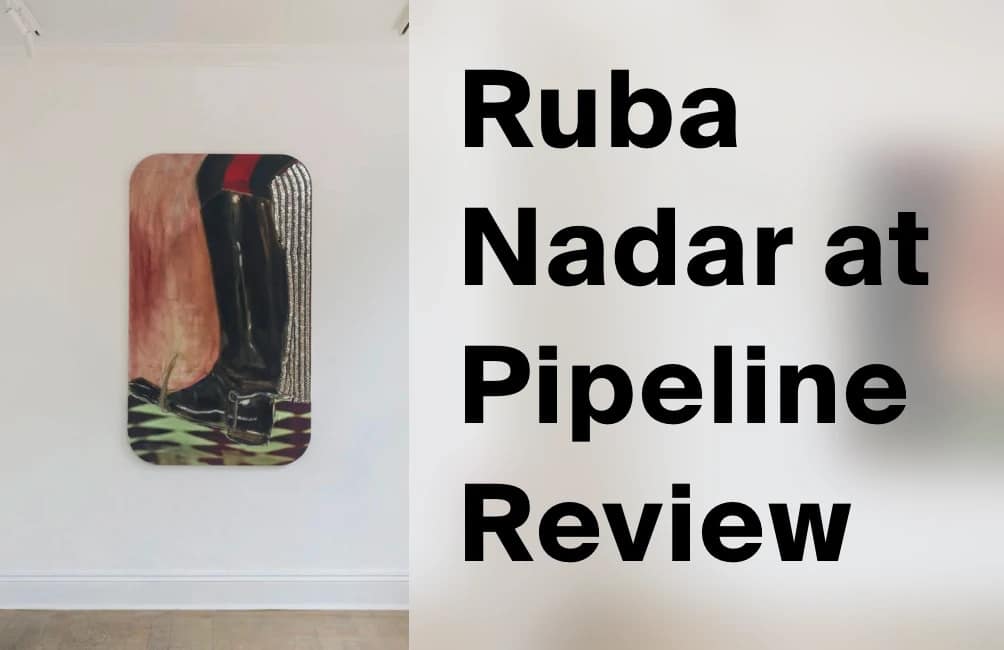
The Ruba Nadar exhibition rewards the kind of looking that gallery visits do not always allow time for. The surfaces repay patience. Underneath a sweep of overpaint, a strip of inherited fabric holds its texture. A colour borrowed from an Egyptian cinema still rhymes unexpectedly with a hand-drawn pastel stripe in the colours of the Egyptian flag. These formal decisions feel instinctive rather than calculated, which is precisely what makes them convincing.
Sport imagery and athletic apparel appear throughout, but not as theme in any heavy-handed sense. Instead, they function as one visual language among several, each carrying different associations around belonging, performance, and aspiration. The title painting pulls together hand-drawn pastel stripes, evoking a flag, with a phrasing that suggests longing still in progress. It is quietly affecting, and it earns its place at the centre of the show.
Nadar's broader practice draws on the writing of Felix Gonzalez-Torres, who described identity as a compilation of shifting texts and histories. You feel that influence here, but the work is not derivative. Rather, it uses that framework as permission to be genuinely personal rather than generically political. The result is a body of work that speaks about diasporic experience without reducing it to a single legible statement.
For anyone building a longer day of exhibition visiting in central London, a National Art Pass is worth considering: it provides free or discounted entry across hundreds of UK venues and makes days like this far easier to plan around.
Value for money
Entry to Pipeline Contemporary is free. The gallery is open Wednesday to Saturday, 11am to 6pm, and the Windmill Street location sits within easy walking distance of Goodge Street and Tottenham Court Road stations. Once you have made the climb to the gallery, you are rewarded with a focused, thoughtfully hung show that does not outstay its welcome.
It is also worth noting that catching an artist like Nadar at the very beginning of a career, before the group-show momentum builds into something larger, is a particular kind of pleasure. The same applies to following a curator like Andrew Price at this stage. Both feel, right now, like genuinely good bets.
The verdict
This Ruba Nadar exhibition is a confident, cohesive debut that suggests an artist already thinking seriously about what painting can do when it stops trying to be just one thing. The work is personal without being solipsistic, and formally inventive without showboating. Pipeline is exactly the right setting: intimate enough to give each work real time, focused enough that the show reads as a whole. Andrew Price's curatorial framing adds further depth, bringing clarity and intent to a practice that might, in other hands, have been left to speak for itself without sufficient context.
Cool Factor: 4/5 Stone cold. Overall, this is a clear 4/5 Stone cold. The visual intelligence on display, for a first solo exhibition, is genuinely impressive, and the emotional coherence of the show as a whole makes it more than the sum of its parts. It stops short of Ice cold only because the intimate scale, though entirely right for this work, means the show does not yet have the physical impact of a larger survey. That is, however, a structural observation rather than a criticism. Climb the stairs. For full details and opening hours, visit the Pipeline Contemporary website.
Frequently asked questions
Is the Ruba Nadar exhibition free to visit?
Yes. Entry to Pipeline Contemporary is free. The gallery is open Wednesday to Saturday, 11am to 6pm, at 31 Windmill Street, London W1T 2JN. Note that the gallery is up several flights of stairs, so it is worth bearing that in mind if you have mobility considerations.
Who is Ruba Nadar?
Ruba Nadar is a London-based artist born in 1998 to Lebanese and Egyptian parents. She completed an MA in Painting at the Royal College of Art in 2024 and a BA in Art History at Barnard College, Columbia University, in 2021. She has shown in group exhibitions across London and New York, including at Guts Gallery and Fitzrovia Gallery. I Saw Myself Playing on The National Team is her first solo show.
Who is Andrew Price?
Andrew Price is a London-based curator educated at Goldsmiths, University of London, who currently works at Lisson Gallery. His recent curatorial projects include More than the Ear Can Hold, a two-person show featuring Ella Belenky and Daniel Pettitt at Unit 1 Gallery | Workshop, London (November 2024), and Susan Hiller's Dedicated to the Unknown, which he took to Culturgest in Lisbon in 2025. He curates the Visiting Curator Program at Pipeline Contemporary.
What is Pipeline Contemporary?
Pipeline Contemporary is an exhibition and project space in Fitzrovia, London, founded in 2022 by Tatiana Cheneviere. It focuses on emerging artists and operates a distinctive model: ahead of each show, a single work by the next artist is presented in a separate enclosed room, giving visitors advance context for the forthcoming exhibition. The gallery has also collaborated with Castlefield Gallery in Manchester.
What kind of work does Ruba Nadar make?
Nadar works in mixed-media painting and collage, using a bricolage approach drawing from vintage sports magazines, Egyptian cinema stills, family photographs, digital screenshots, and inherited fabrics. She tears, stitches, staples, and overpaints these materials into layered, cinematic compositions exploring identity, belonging, and cultural memory.
More from CoolCuration
- Christine Kozlov at Raven Row: our review of a sharp conceptual art show in London
- Rose Wylie at the Royal Academy: our take on an essential London art moment
- William Nicholson at Pallant House: a quietly stunning show, reviewed
- The National Art Pass: is it worth it for regular gallery visitors?
- Gifts for artists and creatives: our curated picks
What's trending




Recent posts
- Best ETF Platform UK 2026: What It Really Costs to Hold ETFs
 Which is the cheapest way to hold ETFs in the UK? I priced eight platforms on the same job, on a £2,000 pot and a £20,000 one, and the ranking flips.
 - Figma Creator Micro Review: Beautiful, But Do You Need It?My Figma Creator Micro review: beautiful design and admirable build, but a price I found hard to justify. Cool Factor 3/5.
- New on Mobbin October 2026: Jomo, Delphi, Lloyds and MoreNew on Mobbin October 2026: Jomo, Delphi, Lloyds and five more apps, with the consent, search and unlock screens worth studying.



No Comments.