
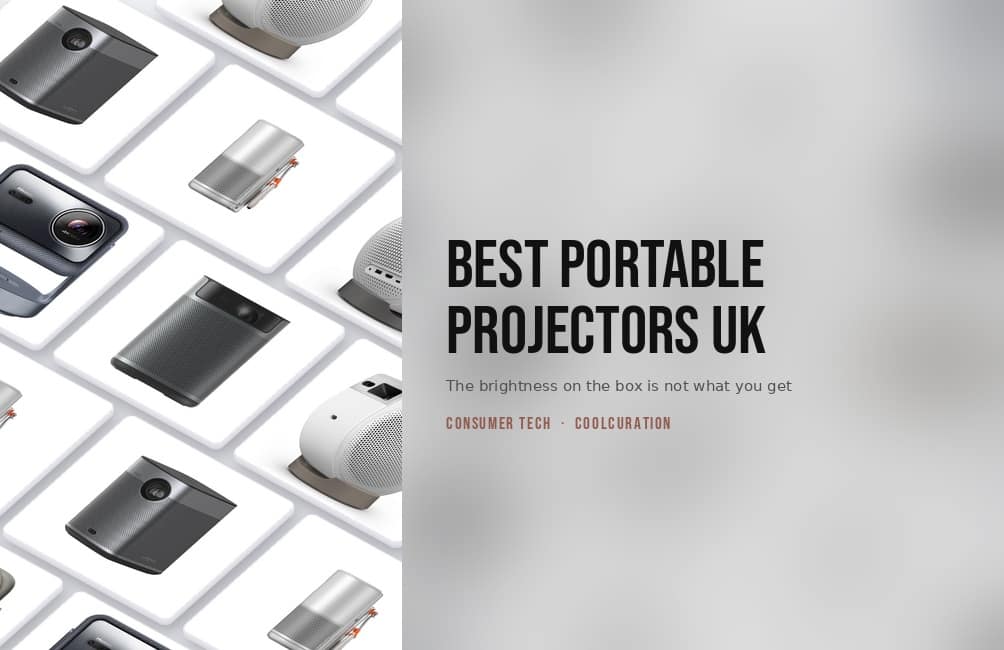
Last updated 2 October 2026
By Stiv · Design, technology and personal finance
This article contains affiliate and referral links, which are paid links. If you click one and buy or sign up, I earn a commission or referral bonus at no extra cost to you. Brands don't choose what I feature or what I say about them.
The brightness number on the box is not the brightness you get
A projector changes what a winter evening in a flat feels like more than anything else at the money. The clocks go back on 25 October, so people start looking about now. Most guides to portable projectors UK buyers land on simply copy the maker's own brightness claim into a table. That number is the one thing on the box you cannot trust.
Optoma prints both versions on the same page. Its ML1080 spec sheet says 1,200 lumens in one row and 550 in the row underneath marked ANSI, which is the measured standard. Same projector, same table, and the big number is the one the shops put in the listing title. So this guide does the obvious thing instead: it ranks on ANSI, it says plainly when a manufacturer will not publish an ANSI figure, and it sorts the picks by the room they suit rather than by battery life.
Every price in this guide was checked on 2 October 2026 at the retailer each button points at. Prices in this category move weekly, and they fall off a cliff in late November.
The eight portable projectors UK shops are selling now
Section 01 / The finding
Four different units, all of them called lumens
One projector, two brightness numbers, and a factor of 2.18 between them.
Start with Optoma, because Optoma is the one that shows its working. The ML1080 specification page carries a row reading "Brightness: 1,200 lumens" and, directly beneath it, "ANSI brightness: 550". Both are Optoma's own figures for the same machine. Amazon's listing title for it says 1,200. Nobody is lying, exactly, but the number that reaches the buyer is more than twice the one that describes the picture.
Here is what the units actually mean. ANSI lumens is the average brightness measured at nine points on the screen, and BenQ calls it the only brightness measure certified by an international body. LED lumens is measured by a method, in BenQ's words, "designed by the companies themselves". BenQ puts the conversion at LED lumens divided by 2.4. Light source lumens is measured at the lamp rather than at the wall, and converts at roughly 0.04 to 0.06. That is how a £99 box advertises 12,000 lumens and delivers something nearer 600.
ISO lumens is not a weaker number, though
This trips up a lot of buying guides. ISO 21118, the international standard for projector brightness, and ANSI are the same measurement. Epson says so directly: the American standards body has adopted ISO 21118, so a brand moving its label from ANSI to ISO has changed the wording, not the spec. XGIMI publishes ISO figures. Those are comparable with BenQ's ANSI figures, and I have treated them as such throughout.
The same Epson release explains what happens when the number is wrong. Under a settlement, Formovie corrected the white brightness of its Theater model from 2,800 lumens down to 1,800, and its P1 from 800 down to 250. Consequently, both versions of the Theater figure are still sitting on Amazon UK today, on different listings for the same projector.
Section 02 / Method
How I picked these, and what the chip really is
Every projector here is one you can buy in the UK today, at a price I read at the till.
Three rules ran this shortlist of portable projectors UK shoppers can actually buy today. First, the maker has to publish a brightness figure in a named unit, or I say out loud that it does not. Second, the thing has to be on sale in the UK now, from a shop a reader can actually use. Third, each pick carries one named flaw, because a list where everything is excellent is a list nobody believes.
Why 4K on a portable is a 1080p chip working hard
Then there is resolution, which is the second place the marketing runs ahead of the hardware. Manufacturers state the chip size and the output resolution, but not the number of mirrors on the chip. Texas Instruments makes those chips and publishes the mirror count, so the two can be put side by side.
| Chip (the mirror array, or DMD) | Mirrors on it | Sold as | Used in |
|---|---|---|---|
| 0.23in DMD | 960 x 540 | 1080p | XGIMI MoGo 4, MoGo 4 Laser, MoGo 2 Pro (New) |
| 0.33in DMD | 1,368 x 768 | 1080p | XGIMI Halo+ |
| 0.47in DMD | 1,920 x 1,080 | 4K | Hisense C2 and M2 series |
Every one of them shifts the mirrors fast enough to paint more pixels than it has. It is a real technique and it works reasonably well, but it means "4K" on a portable projector is a 1080p chip doing overtime. Hisense states as much without meaning to: its own M2TUK Pro page boasts of a system that "controls 2.07 million micro mirrors", which is exactly 1,920 x 1,080. Meanwhile the same page sells the projector as 4K Ultra HD 3840 x 2160.
None of this makes them bad. It does mean the honest way to shop is on brightness, on the operating system, and on whether the room has curtains, because those three decide what you see.
Section 03 / Under £400
The tier where you have to be careful
Below about £300 the category is mostly no-name boxes quoting a unit that does not exist.
Search for a cheap projector and the results fill with £89 to £150 machines claiming 12,000, 15,000 or 20,000 lumens. Apply BenQ's own conversion and 12,000 light source lumens lands somewhere between 480 and 720 ANSI. In practice it is usually far less, because none of those sellers publishes an ANSI figure to be held to. Therefore my advice at that price is to keep the money and buy nothing, or stretch to the one below.

XGIMI MoGo 2 Pro (New)
430 ISO lumens, Google TV with Netflix licensed and installed, and a measured fan noise of 28dB at a metre. For a dark spare room or a bedroom ceiling, that is enough light, and the Google TV part removes the single biggest annoyance in this category.
The cheapest one here I would actually spend my own money on.
The flaw. It has no battery. XGIMI's own spec table lists battery capacity and battery playtime as a blank, so despite the MoGo name this is a mains-powered projector. It also runs the 0.23in chip, so the 1080p is shifted.
£389
Also £269.00 on Amazon UK.
Section 04 / £400 to £650
The sweet spot, and it is a crowded one
Five machines within £220 of each other, and the differences between them are not the ones on the box.

BenQ GV32
500 ANSI lumens, a real ANSI figure from a maker that publishes one on every spec sheet, and 24dBA in eco mode. That makes it the quietest machine under £600 here by a clear margin, which matters more than people expect at two metres from your head.
The quietest picture at this money, and the numbers are honest.
The flaw. No battery, and BenQ says so itself: the GV32 has a "non-built-in battery design and requires external power". It exists partly as the replacement machine for a recalled model, which I cover further down.
£429, on pre-order

XGIMI MoGo 4
450 ISO lumens, a 71.28Wh battery good for up to 2.5 hours of video in eco mode, and a stand that swings through 360 degrees so you can point it at a ceiling without a stack of books. Google TV runs licensed Netflix out of the box.
The first one on this list you can carry outside and switch on.
The flaw. XGIMI does not publish a contrast ratio for it at all, which is unusual and not encouraging. It is also the 0.23in chip again, and 450 ISO lumens is 50 fewer than the BenQ forty pounds cheaper.
£469
Also £378.00 for Prime members on Amazon UK.

XGIMI Halo+ (New)
700 ISO lumens is the brightest figure of any Google TV pick here, and it comes off the bigger 0.33in chip, so there is less pixel shifting going on as well. Battery playtime is 2.5 hours of video. Google TV, Netflix licensed.
Buy this one if the room will never be properly dark.
The flaw. XGIMI sells two products called Halo+ and they are £180 apart. The £439 one runs Android TV, where XGIMI's own support page tells owners to use a TV stick for Netflix. The £619 one, labelled Halo+ (New), runs Google TV with Netflix built in. Buy the wrong one and you are buying a dongle. XGIMI also publishes no fan noise figure for either.
£619
Check the Halo+ (New) at XGIMI UK
Also £478.99 on Amazon UK, where the listing is titled Halo+ GTV.
Optoma prints 1,200 and 550 on the same page. Only one of them is the picture.

XGIMI MoGo 4 Laser
550 ISO lumens from a laser rather than an LED, 90% of the DCI-P3 cinema colour range that films are graded in, a published 1000:1 contrast ratio and the same 2.5 hour battery as the MoGo 4. Laser light sources hold their colour better as they age, which is the real argument for one.
The colour is the upgrade here, not the brightness.
The flaw. It costs £180 more than the MoGo 4 for 100 extra ISO lumens, and it is still the 0.23in chip underneath. If your room is dark, the cheaper one gives you the same picture size.
£649
Also £459.00 for Prime members on Amazon UK.
BenQ GV50

The GV50 is the only one here with a certified brightness figure, a battery and licensed Netflix in one box.
500 ANSI lumens from a laser, a proper 1080p picture, officially certified Netflix on Google TV, 22.4ms of input lag if you want to put a console on it, and a battery. BenQ reckons 100 inches from three metres. Above all, it is the only machine here that gives you a certified ANSI figure, a battery and licensed Netflix in one box.
Everything I actually care about, in one machine, for under £600.
The flaw, and BenQ publishes it. On battery the projector runs at about 70% of its brightness, and below 20% charge it drops to 20%. So the 500 ANSI lumens is a mains figure. Treat the battery as a convenience rather than as the way you will watch things.
£579, or £549 for Richer Sounds VIP Club members
Richer Sounds also sells it new through Amazon UK at £569. The £510.29 offer on the same Amazon page is a used Amazon Resale unit.
Section 05 / £1,000 and up
Where it stops being a gadget
Neither of these has a battery. Both of them will beat a television on a wall you cannot fit a television to.
Hisense M2TUK Pro

Triple laser and a 1.0 to 1.3 optical zoom, so it fills a wall from wherever the sofa already is.
Triple laser, Dolby Vision, Hisense's VIDAA software with Netflix as a native app, and an optical zoom running from 1.0 to 1.3, so it fills a wall from wherever the sofa already is. Richer Sounds quotes 1,300 lumens and bundles a six year guarantee, which is the longest cover on anything in this guide.
The first one on the list that works with the curtains half open.
The flaw. Hisense publishes no brightness figure at all on its own UK page for this projector. The 1,300 lumens comes from the shop, not the maker, and no measurement standard is attached to it. There is no battery either.
£999

Hisense C2TUK Ultra
Hisense's own page promises "3000 lumens brightness", and at that level you stop planning the evening around sundown. The zoom range of 0.9 to 1.5 is the widest here, so it will throw 65 inches from 2.2 metres or fill most of a wall from the back of the room.
The one that survives a room with the lights on.
The flaw. That 3,000 sits in marketing copy with no unit standard named, which after everything above should make you cautious rather than excited. Amazon also sells it new at the same £1,599.
£1,599
Section 06 / The gotcha
The Netflix problem, and which ones just work
This is the thing people discover after the box is open.
Netflix licenses its app per device, and a projector running plain Android TV usually does not hold that licence. Sideloading gets you a phone-shaped version you drive with a mouse pointer, which is nobody's idea of a film night. Google TV models, by contrast, generally ship with the real app already installed.
XGIMI publishes a model-by-model list on its support site. The Google TV machines, which include the MoGo 4, the MoGo 4 Laser, the MoGo 2 Pro (New) and the Halo+ (New), come with licensed Netflix built in. For its Android TV machines, XGIMI's own advice is to use a TV stick. BenQ is blunter still, and states on its GV11 page that Netflix "is not natively available on BenQ smart home projectors", although the GV50 is specifically certified for it. Hisense runs VIDAA, its own television software, where Netflix is a native app.
The practical answer. If a projector does not say Google TV, Samsung Tizen or Hisense VIDAA on the box, budget another £40 for a streaming stick and a spare HDMI port. Equally, check that the projector has a spare HDMI port before you rely on that plan.
Section 07 / The room
What the room has to do
Throw distance, ambient light, and whether you really need a screen.
Throw ratio tells you the picture size from a given distance. Almost everything here is 1.2:1, which puts roughly 75 inches on the wall from two metres and about 94 inches from two and a half. That is the coffee-table distance in most British sitting rooms, so a 1.2:1 machine is the safe default. Short-throw models want to be closer than you think, and Hisense's zoom lenses are the flexible option if the sofa cannot move.
Ambient light beats everything
Brightness only matters relative to the light already in the room. Under 500 ANSI lumens you want the curtains shut and the lamps off. Between 500 and 1,000 you can leave a lamp on behind you. Above 1,300 you can watch in the afternoon, though never in direct sun. Because of that, the room decides the budget far more than the feature list does.
A screen, or the wall
A flat, matt, pale wall is fine, and it is what most people should start with. Magnolia works. Anything with a sheen bounces light back unevenly, and textured plaster softens the picture. If you want a screen later, a £60 pull-down one on the ceiling gains you more contrast than £200 of extra projector, because it controls where the light goes rather than making more of it.
One more practical thing. These all stream over Wi-Fi, and a projector in the far corner of a flat is exactly where a weak signal shows up as a stuttering picture. I wrote about fixing that in my TP-Link Roam 7 review. For the battery models, a laptop-grade power bank extends an evening usefully, and I went through what the new cell chemistry changes in my guide to semi-solid-state power banks.
Section 08 / Avoid
What I would not buy, and why
Three of these, and one of them is a safety matter.
The BenQ GV31, because it is recalled
BenQ has recalled the GV31 outright. Its notice says the battery "may overheat and pose a fire risk" and tells owners to "stop using it immediately". Every unit is covered, no proof of purchase is needed, and BenQ will either replace the battery free or upgrade you to a GV32. If you already own one, the details are on BenQ's recall page. You will still see GV31s listed in places, so check the model number before a bargain tempts you.
Samsung The Freestyle, 2nd Gen, at £399
This one hurts, because the design is lovely and the Tizen interface is the best in the category. But Samsung publishes no brightness figure and no resolution figure for it anywhere on its UK product page. I read the whole spec table. The "230 lumens" in the John Lewis title is the shop's number, with no standard named, and 230 of anything is dim. Samsung's own UK store now lists it as no longer available, which tells its own story. For £10 less you can have the XGIMI MoGo 2 Pro (New) at 430 ISO lumens instead.
Anything quoting five figures of lumens
A £99 projector advertising 12,000 lumens is quoting light source lumens, or a unit it invented. Convert it honestly and the picture is dimmer than the £389 XGIMI. These also tend to run Android without a Netflix licence, at which point the streaming stick costs a third of the projector.
Section 09 / Limits
What I do not know
The limits of this guide, stated plainly.
I have not lived with all eight of these portable projectors UK shops are selling this autumn, so there is no long-term reliability verdict here and I am not going to invent one. Nor do I have a lab, so every brightness figure above is the manufacturer's own or, where I have said so, the retailer's. Nobody independent has measured them.
Prices are the shakiest part. They move weekly in this category and they collapse around Black Friday, which is why the check date sits at the top of the page rather than buried. And the BenQ GV32 is on pre-order at Richer Sounds rather than in stock, so the date you can actually have one may slip.
Finally, the enthusiast tier sits just above this guide and is worth knowing about. Valerion sells directly in the UK from about £1,699, Formovie and AWOL Vision come through specialists at £2,500 and up, and those machines are bought for a dedicated room rather than a coffee table. A projector also makes an obvious Christmas present, and if that is why you are here, my best Christmas gifts guide has the rest of the list.
Portable projectors UK: frequently asked questions
How many lumens do I need for a projector in a normal living room?
With the curtains shut and the lamps off, 400 to 500 ANSI lumens gives a good 80 inch picture. With a lamp on, you want 700 upwards. To watch in daylight you need 1,300 or more, and even then not in direct sun. Those figures assume ANSI or ISO lumens, not the inflated units below.
What is the difference between ANSI lumens and LED lumens?
ANSI lumens is measured at nine points on the screen to an international standard. LED lumens is measured by a method each manufacturer designs itself, and BenQ puts the conversion at LED lumens divided by 2.4. Light source lumens is measured at the lamp and converts at about 0.04 to 0.06. ISO lumens, confusingly, is the same thing as ANSI rather than a softer version of it.
Can you watch Netflix on a portable projector?
On some of them, natively. Google TV, Samsung Tizen and Hisense VIDAA models carry a licensed Netflix app. Plain Android TV models usually do not, and the workaround is a phone-sized app driven by a mouse pointer. Every pick in this guide except the cheap-tier warning runs a licensed Netflix app.
Do I need a projector screen or will a white wall do?
A flat, matt, pale wall is fine to start with. A screen helps most in a room you cannot fully darken, because it controls reflections rather than adding brightness. A £60 pull-down screen buys more visible contrast than £200 of extra projector.
Are battery projectors worth it?
Only if you will really carry it outside. Batteries run 2.5 hours at best, and BenQ's own figures show the GV50 dropping to about 70% brightness once it is off the mains. Four machines sold as portable have no battery at all: the XGIMI MoGo 2 Pro (New), the BenQ GV32 and both Hisense models.
Is a projector better than a TV for the money?
For picture size, easily. £600 buys you 100 inches from a projector and about 50 inches from a television. For brightness, contrast and daylight viewing, the television wins at every price. So the honest test is whether you watch mostly in the evening, and whether you can darken the room.
How far back does a projector need to be?
At the usual 1.2:1 throw ratio, two metres gives roughly 75 inches and two and a half metres gives about 94. Measure from the lens to the wall, not from the sofa. Hisense's zoom models are the ones to look at if the furniture cannot move.
More from CoolCuration
- Best budget turntables UK: seven decks under £300, every price checked, plus why suitcase players wreck records.
- MUBI UK: the streaming service worth pointing a new projector at, with the small print on its weekly cinema ticket.
- Gifts for homebodies: the rest of the cosy-evening list, for people who would rather stay in.
- Sonos Era 300: because the speakers built into every projector here are the weakest part of them.
- Refurbished tech UK: how the grading ladders actually work if you would rather buy last year's model properly.
Prices and availability change. I check them again the day before anything publishes, but do confirm at the retailer before you buy.
What's trending






Recent posts
- Best Portable Projectors UK 2026: What £400 to £1,600 Buys
 Optoma prints 1,200 lumens and 550 on the same spec sheet, for the same projector. Eight portable projectors I would actually buy this winter, sorted by the room they suit, with every UK price checked at the till. #projectors #homecinema #uktech #gadgets #winterevenings
 - Siri AI Review: Living With Apple’s New SiriMy Siri AI review after three weeks of daily use on an iPhone 18 Pro and a Mac: what works, the daily connection errors and why it scores 3/5 Cool.
- This Is Still Not a Pipe Review: Magritte at GagosianMy This Is Still Not a Pipe review: around fifty Magrittes and 46 artists who followed him, free at Gagosian until 12 December. Cool Factor 5/5.
No Comments.