
Last updated: 20 September 2026
By Stiv · Design, technology and personal finance
This article contains affiliate or referral links. If you click through and buy I may earn a commission at no extra cost to you. It does not affect my editorial view.
Want the first one Belkin shipped?
The UltraCharge Pro 5K is the flagship of the two and the only one with magnets. My full reference page has the specifications, the conflicts and both UK buying routes.
Buy the UltraCharge Pro 5K on Amazon, £59.99 Read the full 5K page
Belkin put a gel in a battery. Then it published three different sets of numbers about it.
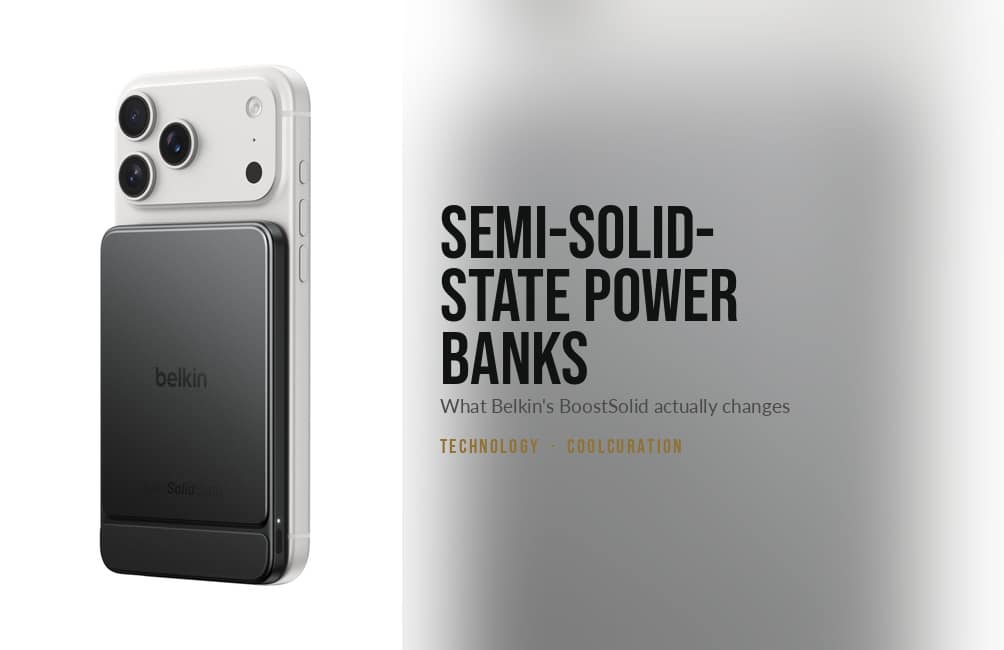
Semi-solid-state power banks landed in the shops this month, and Belkin got there first with a cell it calls BoostSolid. The pitch is a thinner pack that lasts three times longer. But Belkin's press release, Belkin's own UK product pages and Belkin's own Amazon listings disagree with each other on seven specifications, and I only found that by reading all three.
Section 01 / The launch
What Belkin actually announced
Two power banks, one new cell, and a booth at IFA.
On 3 September 2026 Belkin announced the UltraCharge Pro range with BoostSolid Cell, showing it at IFA 2026 in Exhibit Hall 3.2, booth 117. Two products carry the new cell. First, the UltraCharge Pro Slim Magnetic Power Bank 5K, at £59.99 and 8.8mm thick, with Qi2 magnets. Then the UltraCharge Pro Power Bank 10K with Display, at £69.99, with three ports, 60W, and no magnets at all.
Both are on sale directly from belkin.com/uk now. On Amazon UK, meanwhile, both were pre-orders until 16 September 2026. So if you have seen a headline saying you cannot buy these yet, that was true when it was written. It is not true today.
Those two are the only semi-solid-state power banks on sale in the UK today. Belkin also showed SureFind trackers at the same event. Those have no Amazon UK listing and no confirmed UK price, so I have left them alone.
Section 02 / The chemistry
What semi-solid-state actually means
A gel layer alongside the liquid, not instead of it.
An ordinary lithium cell moves ions through a liquid electrolyte. That liquid is what makes a battery flammable, and it is also why a punctured or overheated pack can run away with itself. A true solid-state cell, by contrast, replaces the liquid entirely with a solid conductor. That is the technology everyone has been promising for a decade, and nobody is selling it in a consumer power bank.
Semi-solid-state power banks sit between the two. Belkin's own wording is exact and I am going to quote it rather than paraphrase, because the paraphrases I have read elsewhere all drift: BoostSolid "adds a gel-like layer alongside the liquid electrolyte". The liquid is still in there. This is not a solid-state battery, Belkin does not claim it is one, and anyone selling it to you as one has dropped a word that changes the meaning.
What the gel buys is density and stability. Specifically, less liquid means a thinner stack for the same capacity, plus a cell that tolerates heat and physical abuse better than a pure liquid cell would. Those are real engineering gains. Even so, they are incremental rather than revolutionary, which is roughly what you would expect from a first generation.
Section 03 / The pitch
Why 8.8mm matters more than it sounds
Thinness is the only thing you notice every single day.
Belkin's UK spec table gives the 5K as 104 x 72 x 8.8mm, and the plain reading of that is a credit card with a bit more height. Stuck on the back of a phone with the magnets, that is the difference between a pocket that closes and a pocket that does not.
Capacity is the number people compare in a shop. Thickness, though, decides whether the thing gets carried at all. After all, a 10,000mAh pack that lives in a drawer delivers nothing. So Belkin spending the new cell's density on thinness rather than on more milliamp-hours is, to me, the right call for a magnetic pack.
The 5K is 190g. The 10K is 440g and 15mm thick, and it is a bag item rather than a pocket item. That gap is bigger than the price gap between them.
Section 04 / The small print
The 3x claim, and the footnote holding it up
Read the asterisk. The asterisk is where the argument lives.
Belkin says the UltraCharge Pro range is "engineered to last up to 3x longer than other power banks". Then the footnote defines it. The cell retains up to 80% of its capacity after 1,000 charge cycles, and the estimated five-year lifespan "assumes one full charge/discharge cycle every two days".
Take the two halves separately, because they do different jobs. First, the 1,000-cycle rating with 80% retention is a genuine engineering claim. It is measurable, and it is good. Typical consumer lithium packs are rated somewhere between 300 and 500 cycles to the same threshold, so two to three times is a fair description of the improvement.
The five-year headline attached to it is arithmetic about a person who does not exist. Flattening and refilling a 5,000mAh power bank 182 times a year is not how anyone uses one. Charge it weekly, which is far more typical, and 1,000 cycles is nineteen years away. The cell will not be what fails first.
assumes one full charge/discharge cycle every two daysBelkin's own footnote to the 3x claim
None of that makes the claim false. Rather, it makes it a claim about the cell instead of a promise about your pack, and those are different things. My honest read is that BoostSolid will still be holding a useful charge when the USB-C port has worn out or the plastic has cracked. That alone is a good enough reason to prefer it.
Section 05 / Safety
The safety argument, and what a buyer can check
Some of this is verifiable. Most of it is not, and it matters which is which.
Belkin's safety case has three parts. The chemistry reduces the risk of thermal runaway, fire and swelling. Dual analog and digital temperature sensors watch the cell and cut power if it goes outside its limits. And the pack is designed to meet UL2056:2025 requirements and TSA carry-on guidance.
The first is plausible, and consistent with what semi-solid chemistry does elsewhere. The third is checkable in principle. However, "designed to meet" is a softer statement than "certified to", and Belkin has published no certificate number for either pack.
The second is where the sources fall apart again. The press release says the sensors read the cell every 250 milliseconds. Belkin's own UK product page says every 20 milliseconds, and so does the Amazon listing. That is a twelve-fold difference in a safety specification, published by one company in one week. I cannot tell you which is right, and neither can Belkin's website.
Belkin naming TSA carry-on guidance at all is a tell. Power banks in cabin baggage are a live safety subject, so a maker leading on thermal behaviour is answering a real question. It just needs to answer it with one number rather than two.
Section 06 / The finding
Three Belkin sources that do not agree
Seven specifications, read at three places Belkin controls.

Every figure read at a Belkin-controlled source on 20 September 2026. Not one of them is a third-party estimate.
I built that table by opening the press release, then Belkin's UK product pages for BPD024hqBK and BPB044hqBK, then Belkin's own Amazon UK listings, and writing down the same seven specifications from each. Every discrepancy above is Belkin against Belkin. No review sites, no leaks, no rumour.
Some of the gaps have an innocent explanation. For example, the 22.5W and 20W figures for the 5K are both true. The port does 22.5W under Samsung's SFC protocol and up to 20W under USB Power Delivery, and Belkin's footnote says exactly that. Retail copy simply picked the number most of its buyers will see.
Others have no explanation at all. Twenty milliseconds against 250. Twenty-four minutes against twenty. Zero to forty degrees against minus ten to sixty. Those are not two ways of describing one measurement.
So my working rule is simple. Where the press release carries an internal-testing footnote and the product page repeats it, that is the number Belkin will stand behind. Retail copy, by contrast, is the number Belkin would like you to remember.
Section 07 / The two packs
Which of the two you actually want
They are not a small one and a big one. They are two different objects.
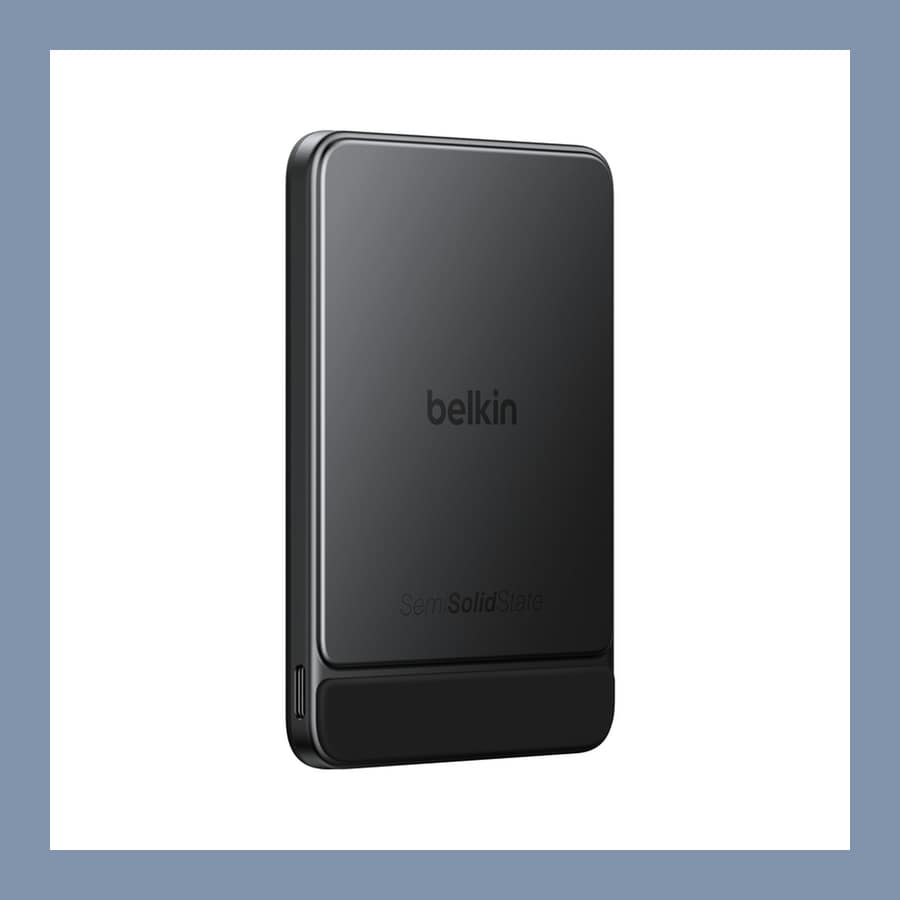
UltraCharge Pro 5K
For the phone in your pocket, and nothing else.
Qi2-certified at 15W, so it snaps onto the back of an iPhone or any Qi2 phone with no case adapter needed. It is 8.8mm and 190g. Wired charging runs at 22.5W under SFC or up to 20W under PD, while pass-through works at 7.5W wirelessly. Five thousand milliamp-hours is about one phone charge once conversion losses come out, so treat it as an evening rather than a weekend.
£59.99, Black or Sand
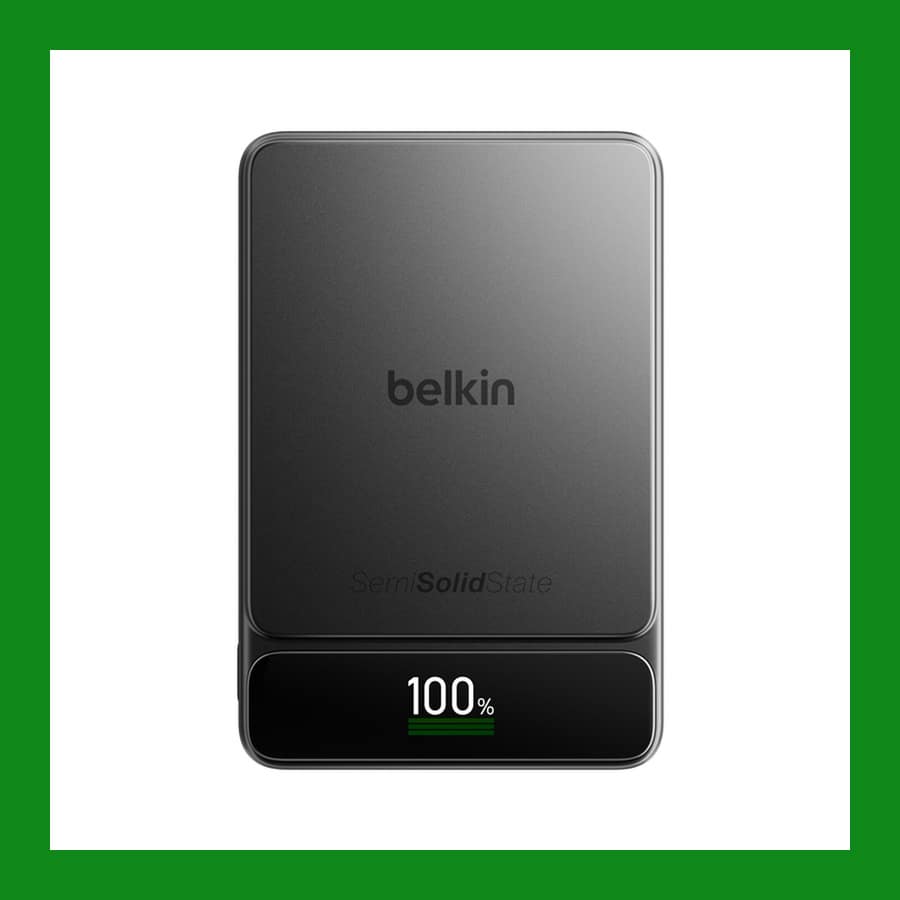
UltraCharge Pro 10K with Display
For the bag, the laptop and the long day.
Two USB-C ports and one USB-A, up to 60W on a single port, and a screen that reports the charge as a percentage rather than as four LEDs. It takes 40W in, so it refills quickly. However, there are no magnets and no wireless charging of any kind. At 440g and 15mm it is more than twice the 5K in both, which is a bigger jump than the £10 between them suggests.
£69.99, Black or Sand
If you carry a phone and want the pack to disappear, take the 5K. If instead you charge a laptop or a tablet, or you want to know exactly how much is left, take the 10K and accept that it lives in a bag. Above all, do not buy the 10K expecting magnets. The two look alike in a launch photograph and only one of them sticks to anything.
For a different argument entirely, my page on the Gomi power bank covers a British-made pack cast from recycled plastic waste and designed to be opened and repaired. Admittedly it is thicker, slower and more expensive per milliamp-hour. But it is the only power bank I have listed that you can send back to be rebuilt rather than binned. That answers the same question about lifespan that BoostSolid answers with chemistry, and it answers it a different way.
Section 08 / The third product
The buds are the ones you cannot have yet
Same launch wave, a month further out.
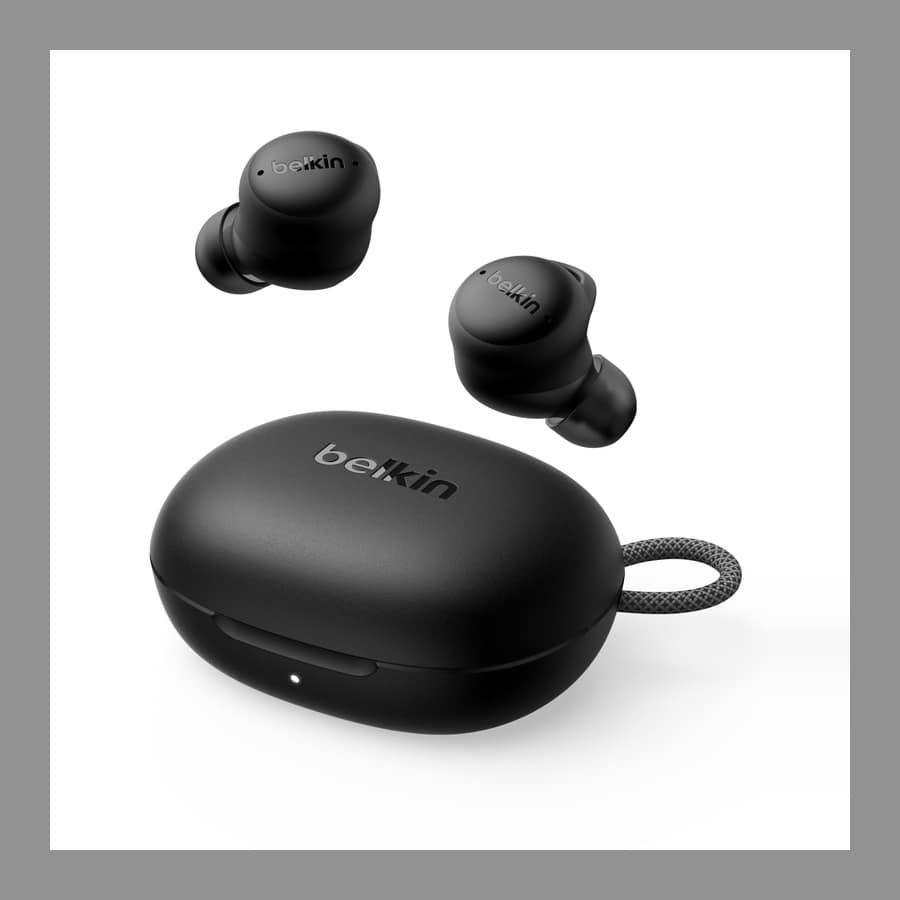
SoundForm Isolate Buds
Hybrid noise cancelling at forty pounds, arriving in October.
Belkin rates the hybrid ANC at -45dB, quotes 34 hours of total playtime, and fits Bluetooth 5.4 with multipoint and IPX5. Amazon UK dates them 15 October 2026 and adds that release dates can move. Belkin has published no product page for them anywhere, so its Amazon listing is currently the only source for any of those numbers.
£39.99, Black, Grey or Orange
That October date is the part to hold onto. The two power banks were announced on 3 September and were on Amazon by the 16th. These, meanwhile, were announced alongside them and land six weeks later. Belkin has not explained the gap, and I am not going to guess at it.
For anything you can compare and buy today, my roundups of the best wireless earbuds in the UK and the best noise-cancelling headphones do the ranking. Those two posts own the recommendation. The detail page owns the specification. This post owns the technology.
Section 09 / The caution
What to watch for in first-generation semi-solid-state power banks
Nobody has lived with one of these yet, me included.
I have not used either pack. Nothing in this post is a hands-on impression, because there has not been time for one and pretending otherwise would be worthless to you. Every performance number above is Belkin's, and I have said so each time one appears.
Three things will decide whether semi-solid-state power banks are a real step or a marketing cycle. First, whether the 1,000-cycle rating holds up in packs people actually own, which nobody can answer for a year. Second, whether the safety architecture gets independently tested rather than described. Third, whether the price premium survives competition. Anker, Ugreen and the rest will ship their own versions, and £59.99 for 5,000mAh is a lot of money right now.
A proper verdict needs one of these in a bag for a month. So I will write that separately, once I have had the 5K long enough to say something honest about it, and that one will carry a Cool Factor score. Today's piece is an explainer instead, which is why there is no score on it.
Semi-solid-state power banks FAQs
Are semi-solid-state power banks the same as solid-state batteries?
No. A solid-state cell has no liquid electrolyte at all. Semi-solid-state adds a gel-like layer alongside the liquid, and Belkin's own wording says exactly that. So the liquid is still in there. The distinction matters because solid-state is the thing that has been promised for a decade, and this is not it.
Are they safer than a normal power bank?
Belkin says the architecture reduces the risk of thermal runaway, fire and swelling. Semi-solid chemistry does behave better than pure liquid cells in the laboratory. However, no independent test of these particular packs exists yet, and Belkin publishes two different figures for how often its own temperature sensors read the cell. So the argument is plausible rather than proven.
How much do Belkin's semi-solid-state power banks cost in the UK?
The UltraCharge Pro 5K is £59.99 and the UltraCharge Pro 10K with Display is £69.99, in Black or Sand each. Both prices are the same on belkin.com/uk and on Amazon UK. Belkin ships direct, and Amazon released both on 16 September 2026.
Does the 5K work with a phone that is not an iPhone?
Yes, provided the phone supports Qi2 or has a magnetic case. Belkin lists Samsung Galaxy S23 through S26 and Google Pixel 7 and 8 among compatible devices, alongside the iPhone 15, 16 and 17 families and the iPhone Air. Wired charging over USB-C works with anything, including both Nintendo Switch models.
Is the 3x longer lifespan claim true?
The underlying cycle figure looks solid. It is up to 80% capacity retained after 1,000 charge cycles, against 300 to 500 for a typical consumer pack. The five-year headline built on top of it is weaker, though, because Belkin's own footnote assumes one full charge and discharge every two days. Almost nobody uses a power bank that hard, so most owners will reach 1,000 cycles far later, if ever.
Should I wait for other makers to release their own?
That depends on whether you need a power bank now. Belkin is first to market in the UK with semi-solid-state power banks, and first is usually the most expensive and the least refined. Equally, a 5,000mAh magnetic pack at 8.8mm is a useful object today. Waiting for a second generation means waiting a year at least.
Where can I read the source material myself?
Belkin's UltraCharge Pro press release carries every claim and every footnote quoted here. The Wireless Power Consortium explains what Qi2 certification does and does not cover, which is worth reading before believing any magnetic charging speed.
More from CoolCuration
- Analogue Pocket: the handheld that made me care how long a battery lasts in the first place.
- Gift guide for travel lovers: what actually earns its space in a bag, sorted by price.
- Best smart speakers UK: the other bit of household tech where the spec sheet and the reality diverge.
- SMARTY Mobile: the SIM-only network I use, and what a month really costs.
- Airtime Rewards: the app that quietly takes money off your phone bill when you shop.
What's trending






Recent posts
- Best Audiobooks October 2026: 10 UK Listens Ranked
 Ten new audiobooks for October 2026, from a full-cast Dracula with Jonathan Bailey to Russell T Davies reading his own television memoir.
 - Louis Fratino at David Zwirner ReviewLast updated: 4 October 2026 By Tristan · Arts, exhibitions and creative culture This is an opinion piece. Views expressed are the author's own and do not constitute professional advice. Exhibition reviewMayfair Saunas, subway cars and a lot of skin in Mayfair Louis Fratino at Zwirner is the American painter's first solo show in London,… Read more: Louis Fratino at David Zwirner Review
- What Is a Sprive Boost? Seven Days, and What It Actually PaysA Sprive boost lifts your cashback rate for seven days, and it arrives on its own. What mine paid, and why Supercharge is a display toggle rather than extra cashback.


No Comments.