
Last updated 28 September 2026
By Stiv · Design, technology and personal finance
Affiliate disclosure: this article contains affiliate or referral links, including Amazon and my Back Market code. If you click through and buy or sign up I may earn a commission or referral bonus at no extra cost to you. It does not affect my editorial view.
This is an opinion piece. Views expressed are the author's own and do not constitute professional advice.
Cool Factor: 4/5
Want £10 off a refurbished iPhone instead?
New Back Market customers get £10 off a first order over £100 with my code. My code page has the current offer and the steps to claim it.
A better camera and a bigger battery, with Siri AI still catching up
My iPhone 18 Pro review comes down to this: Apple has improved the parts of the phone you use every day and asked £100 more for them. The main camera now has a real variable aperture. The cooling is new, and so is a bigger battery in the Pro Max. Siri AI is the headline software feature, and it is the part I rate lowest.
I upgraded to an iPhone 18 Pro, 512GB in Black, from an iPhone 16e. This iPhone 18 Pro review mixes my own use of it with Apple's UK specifications and named lab tests, all checked on 21 September 2026.
Want every iPhone guide in one place? My iPhone guides hub collects the lot, from which iPhone to buy to refurbished deals and SIM-only plans.
What is the iPhone 18 Pro?
The iPhone 18 Pro and iPhone 18 Pro Max are Apple's 2026 Pro phones. Apple announced them at its Surprise and Shine event on 9 September, and they went on sale in the UK on 18 September. The Pro has a 6.3-inch screen and the Pro Max a 6.9-inch one. Both come in Black, Silver, Glacier and a new Burgundy, with 256GB, 512GB, 1TB or 2TB of storage.
Prices start at £1,199 for the Pro and £1,299 for the Pro Max, which is £100 more than the iPhone 17 Pro and 17 Pro Max cost at launch. Prices and specifications here were checked at apple.com/uk and Amazon UK on 21 September 2026. Every storage tier, the trade-in values and the launch dates sit on my iPhone 18 Pro UK price page. If you want the story of what was rumoured before the keynote, that is in what to expect from the iPhone 18.
Apple sums the phone up in one line. Greg Joswiak runs Worldwide Marketing at Apple, and he said this in Apple's launch announcement: "With iPhone 18 Pro, we've made advancements to the areas our users care about most: camera, performance, battery, and intelligence."

Why I went for the Black iPhone 18 Pro
I went for Black. Last year's orange was a little garish for me, and this year's Burgundy is alright but somehow looks old-fashioned. In my experience, the colours age faster than the classics. Still, I find it interesting that Apple has gone full circle on colour. Colour made its Macs friendly, and then the pro devices went black. Over time, white came to mean the less premium MacBook, while pro meant bare aluminium or titanium. Now pro is colourful again, at least some of the time.
Design and build: the 17 Pro's shape, with new cooling inside
From the outside, very little has moved. The aluminium unibody and the raised camera plateau carry over from the iPhone 17 Pro. The front is Ceramic Shield 2, which Apple says has three times the scratch resistance of the iPhone 16 Pro, and the back is Ceramic Shield. Both phones are rated IP68 for water and dust, which means they survive 6 metres of water for up to 30 minutes.
The weight has gone up, though. The Pro weighs 211g and measures 150 x 71.9 x 8.75mm. The Pro Max weighs 249g, which is about the same as a 250g block of butter, at 163.4 x 78 x 8.75mm. That is a heavy phone to hold one-handed, so if you are choosing between the two sizes, try the Pro Max in a shop first.
How the iPhone 18 Pro feels in the hand
Coming from a 16e, the build feels great to me. It is a little heavier, and the top half is slightly heavier because of the cameras. That took some getting used to, especially when I pulled it out of a pocket quickly. On the plus side, I always know which way up to hold it, which is a big win for tactile memory.
The new cooling, and the heat when charging
The real change is inside. Apple has moved the memory so it sits beside the A20 Pro chip rather than on top of it. That takes the memory out of the path the heat travels. The chip then sits directly on a new vapour chamber with three times the surface area of the one in the 17 Pro. According to Apple, that gives up to 40 per cent better sustained performance. In practice, that means long games, video exports and on-device AI tasks should hold their speed for longer before the phone slows itself down to cool off.
Mine does get hot when it charges. I am not sure how much of that is iOS 27 still adapting and indexing after setup, so I hope it settles over time. My guess is that some of the heat is a good sign, because the phone is moving it away from the chip and out to the case. That should help it keep performing. Even so, it feels strange, since a hot phone used to mean a problem.
Display: brighter outdoors, and a smaller Dynamic Island
Both screens are Super Retina XDR OLED panels with ProMotion up to 120Hz and an always-on mode. Apple quotes 1,000 nits of typical brightness, 1,600 nits for HDR (high dynamic range) video, 3,000 nits outdoors and a minimum of 1 nit. There is also an anti-reflective coating, which should help most in direct sun, where glare usually washes out a phone screen.
In my use, the coating does make a difference. It is not game-changing, but the screen is a bit easier to see. It is nothing to get overly excited about, and it will be interesting to see how it ages.
The Dynamic Island is the other change. Apple calls it smaller, and it can now show up to three Live Activities at once, such as a football score, a delivery and your music. Face ID still sits inside it. Meanwhile the resolution stays at 460 pixels per inch on both sizes: 2622 x 1206 on the Pro and 2868 x 1320 on the Pro Max.
Camera: variable aperture, and Pro controls in the Camera app
The camera is the biggest upgrade. The 48MP Fusion Main camera has a variable aperture for the first time on an iPhone. Six laser-cut blades move between four settings: f/1.48, f/1.8, f/2.8 and f/4.0. The camera picks one automatically. At f/1.48 it lets in the most light, which Apple says gives around 50 per cent better low-light performance and faster Night mode shots. At f/4.0, on the other hand, more of the scene stays sharp, so the back row of a group photo is less likely to blur.
Pro controls, and the rest of the camera system
You can also choose the aperture yourself. The new Pro controls put aperture, shutter speed, white balance and a live histogram in the Camera app. You can also move the settings you use most to the top. Photographic Styles 3 adds texture and grain alongside tone and colour. That is a change, because until now manual control on an iPhone meant a third-party app, like the (Not Boring) Camera app I reviewed this month.
The rest of the system is all 48MP. The Fusion Ultra Wide has an f/2.2 lens and also handles macro. The Fusion Telephoto is a 100mm equivalent at 4x, and Apple rates it as 8x optical quality, with digital zoom up to 40x. The front is an 18MP Center Stage camera. Apple has also added smart focus tracking, which holds focus on a subject even if they leave the frame and come back.
Apple Reference Image is the new feature that is easy to miss. In a new Reference mode, the camera signs the sensor data as it shoots, and the Photos app keeps an unalterable copy beside your photo. Anyone can then compare the two and see whether the picture has been edited. Apple pitches it at photojournalists and photographers, whose pictures have to be trusted.
How I use the iPhone 18 Pro camera
I love photography, but I am not a photographer, and I see no point in the manual controls for me. The default Camera app still limits the options and the amount of control, so I let the software handle it. For me, the Pro controls do not enable anything new. That said, I can see the appeal for anyone who is a bit more "pro" than me.
The zoom, on the other hand, is great and useful. The camera array is very much a step up from the single combined lens on my 16e, and I don't think I will go back to an e model. Well, maybe never. I don't take many photos at night or in low light, but it is good to have the option.
Performance: A20 Pro, and the new C2 modem
The A20 Pro is built on a 2-nanometre process. Its 6-core CPU, the main processor, has two performance cores, which Apple calls super cores, and four efficiency cores. The 7-core graphics processor is up to 40 per cent faster than the A19 Pro, according to Apple. There is also a Dual 16-core Neural Engine with 32 cores in total. Apple says it doubles the AI processing power of the previous chip, and memory bandwidth is up 50 per cent.
The practical gain is headroom: the phone should still feel quick in four or five years, and demanding games will run for longer before the chip throttles. Equally, Apple's own C2 modem is in both UK models, according to the UK technical specifications. Apple says it uploads up to 50 per cent faster than the C1X in selected markets and uses less battery. Wi-Fi 7 and Bluetooth 6 come from Apple's N1 chip.
Battery: what the UK figures say, and what lab tests found
Apple's battery claims need one piece of context for UK buyers. The launch headline of up to 36 hours of video on the Pro and 45 hours on the Pro Max applies to eSIM-only models, which have no physical SIM tray. Apple sells those in the US, Canada, Japan and nine other markets, but not in the UK. UK models keep the physical SIM tray, and Apple's UK specifications list shorter figures.
| Battery figure | iPhone 18 Pro | iPhone 18 Pro Max |
|---|---|---|
| Typical use, Apple UK figure | Up to 23 hours | Up to 29 hours |
| Video playback, Apple UK figure | Up to 34 hours | Up to 43 hours |
| Streamed video, Apple UK figure | Up to 31 hours | Up to 38 hours |
| TechRadar web-browsing test | 16 hours 17 minutes | 18 hours 27 minutes |
| Same test, iPhone 17 Pro generation | 15 hours 21 minutes | 17 hours 54 minutes |
Even so, the UK figures are good. Apple says the Pro Max gets 6 more hours of video than the iPhone 17 Pro Max. TechRadar's lab test browses websites over a mobile connection until the battery dies. It found smaller gains: about 6 per cent on the Pro and 3 per cent on the Pro Max. So a 17 Pro owner should expect a bit more battery than last year, rather than a transformation.
Battery life in my own use
Coming from a 16e, my experience is different. The battery is exceptional, and by far the best I have seen on a phone. It lasts two days for me on one charge, and Apple has done a great job here.
Charging speeds, and the adapter you need
Charging has sped up too, but only with the right plug. Apple says both models reach 50 per cent in around 15 minutes with a 60W or higher adapter that supports Adjustable Voltage Supply. That adapter is sold separately, and the box only has a USB-C cable. MagSafe and Qi2 wireless charging both run at up to 25W. With a 35W adapter or higher, Apple says MagSafe reaches 50 per cent in 30 minutes.
For my part, I charge it on a high-wattage Xiaomi wireless charger, though I am not sure of its exact rating, and on the charger that came with my MacBook Pro. It charges fast, easily, and then holds its charge for ages.
Siri AI on iOS 27: slower than I expected
Siri AI is available in the UK, in English, as a beta. I signed up myself: go to Settings, tap Siri, then tap Try Siri AI (Beta). According to Apple's Siri AI support page, you then pick a voice, enrol your voice and review the privacy settings, which adds you to a waitlist. I was on it for less than a week, although Apple has buried the opt-in quite well in Settings. Siri AI is not available on iPhone in the EU. Apple also warns that server-based features, Siri AI included, come with daily usage limits, and that expanded access will cost money in the future.
I use Siri AI on my iPhone and my Mac. Sadly, my Apple TV is too old for it, and HomePod has been left out of this release.
How Siri AI has worked for me
How does it perform? Slower than I expected, and only a little smarter. It is more chatty, for sure, and it is helpful, mostly. The new standalone Siri app lets you resume chats, but weirdly not all of them, and I have no idea why. Apple's support page says the app syncs your chat history through iCloud so you can pick up where you left off. Chats that will not resume therefore look like a beta fault, not the intended design.
Then there are the tasks that went wrong. I tried ordering an Uber, and it did not work. Next I tried adding things to my calendar. It timed out three times, and on the fourth try it added the event on the wrong day. On the other hand, I got it to do some complex maths while reading my phone screen, which was cool.
As a user of Claude and ChatGPT, it feels like the consumer version of AI.Stiv, on Siri AI
So far it is much slower than those two, and I still struggle to see how AI is actually giving normal people anything useful. Siri AI is also why software gets the lowest score in my iPhone 18 Pro review, 3 out of 5. The rest of iOS 27 runs smoothly, and Liquid Glass has more ways to customise it. After three more weeks of daily use I wrote it up properly in my Siri AI review.
Siri AI runs on older iPhones too
One consequence matters if Siri AI is your reason to upgrade. You do not need an iPhone 18 Pro to get it. Apple's support page lists the iPhone 15 Pro, iPhone 15 Pro Max, every iPhone 16 model and later, and the iPhone Air. Consequently, a phone you already own may run it today.
Where the iPhone 18 Pro falls short
Five things held my iPhone 18 Pro review score back from 5 out of 5.
Siri AI. It is the feature Apple leads on, and it is the least finished part of the phone. Adding a calendar event is a basic job for an assistant, and mine timed out or landed on the wrong day. In addition, Apple caps daily use and says wider access will cost extra in the future.
The £100 price rise. Both sizes cost £100 more than last year's launch prices. The storage steps add up fast too: going from 1TB to 2TB costs another £600, and a 2TB Pro Max is £2,499.
Little reason to leave a 17 Pro. The design is the same, and TechRadar measured a 3 to 6 per cent battery gain in its browsing test. The camera and the cooling are the real upgrades. If you shoot a lot in low light or play demanding games, those are worth having. Otherwise, a 17 Pro owner loses very little by waiting a year.
The extra weight. At 249g the Pro Max is heavy to hold for long, and neither model got lighter.
The fast-charging adapter. The 15-minute figure depends on a 60W adapter you may not own, so budget for one if you want that speed.
Who should upgrade to the iPhone 18 Pro?
Upgrade if you are on an iPhone 15 Pro or older and use the camera a lot. The variable aperture, the Pro controls and the 8x telephoto are a real step up from a 15 Pro. You also gain the new cooling and a bigger battery. Anyone on a phone without Apple Intelligence also gets Siri AI for the first time, beta and all.
I came from a 16e, and for me the jump was big: the camera array, the zoom and the battery life all feel like a step up. By contrast, if you already have a 17 Pro, most of the upgrade is the camera. The phone looks the same, and Siri AI already runs on your 17 Pro. That makes this a year to skip for most 17 Pro owners.
If the price is the sticking point, a refurbished Pro is the other route. Back Market lists refurbished iPhone 17 Pro and 17 Pro Max models alongside older Pros, graded by condition. My Back Market review covers how the grades and the returns work, and my best refurbished phones guide compares it with the other UK sellers. New Back Market customers also get £10 off a first order over £100 through my Back Market discount code, according to Back Market's referral terms. Alternatively, if you just want a new iPhone for less, my iPhone 17e review covers Apple's cheapest current model.
Value for money, and where to buy
My iPhone 18 Pro review scores value at 4 out of 5. At £1,199 for the Pro and £1,299 for the Pro Max, the value case rests on the camera and the battery. For someone coming from an older phone, both are big enough upgrades to justify the price. For a 17 Pro owner, they are not. Meanwhile, 256GB is the starting capacity, and the 512GB step costs another £200.
Amazon UK sells both phones itself, at the same starting prices as Apple on the day I checked. Amazon is both the seller and the shipper on the two listings below, and both sit in Apple's own store on Amazon.
iPhone 18 Pro 256GB on Amazon UK, £1,199
iPhone 18 Pro Max 256GB on Amazon UK, £1,299
Buying from Apple directly is the other route, and it is the one to use for a trade-in. The iPhone 18 Pro buy page lists every colour and storage tier, and Apple Trade In gives an instant estimate for your current phone. Full specifications are on Apple's iPhone 18 Pro technical specifications page. For a folding phone, Apple's iPhone Duo arrives in October, and its prices are on my price page.
iPhone 18 Pro review: the scores and the verdict
These are my iPhone 18 Pro review scores, area by area. Software scores lowest, and the reason is Siri AI.
| Area | Score | Why |
|---|---|---|
| Value | 4/5 | £100 more than last year at both sizes, and the camera and cooling upgrades cover most of it. |
| Design | 5/5 | The 17 Pro's shape carries over, with a bigger vapour chamber inside and a new Burgundy finish. |
| Display | 5/5 | 120Hz ProMotion, always-on, 3,000 nits outdoors and a Dynamic Island that shows three Live Activities. |
| Software | 3/5 | iOS 27 runs smoothly. Siri AI is slower than I hoped and only a little smarter. |
| Camera | 5/5 | A real variable aperture on the main camera, plus Pro controls for shutter speed, white balance and a histogram. |
| Performance | 5/5 | The A20 Pro has years of headroom, and the new cooling lets it hold its speed for longer. |
| Battery | 5/5 | Up to 43 hours of video on the Pro Max by Apple's UK figures, 6 hours more than the 17 Pro Max, and two days a charge in my own use. |
Cool Factor
★★★★☆
4 out of 5, Stone cold
Overall, my iPhone 18 Pro review score is 4/5, Stone cold. It earned that with the variable aperture and Pro controls, the new cooling, and a battery that goes further than last year's. It did not reach Ice cold for three reasons. Siri AI is slower than it should be and gets simple tasks wrong. The price has gone up £100. A 17 Pro owner also gets too little for the money. If your phone is two or more years old, it is an easy upgrade to recommend, and it was for me coming from a 16e. If it is last year's Pro, keep it, and wait for Siri AI to catch up.
Buying from Apple? Get 2% back first
I buy Apple Gift Cards in the JamDoughnut app, then spend them with Apple. JamDoughnut paid 2% instant cashback on Apple Gift Cards when I checked on 13 October 2026. The card covers hardware from an Apple Store or apple.com, plus App Store purchases and iCloud+. I bought my Mac this way. Apple takes up to eight gift cards per order, but not alongside PayPal or Apple financing.
Rates can change, so check the app before you buy. My JamDoughnut page uses a referral link.
iPhone 18 Pro review FAQs
Is the iPhone 18 Pro worth it?
My iPhone 18 Pro review verdict is yes if you are coming from an iPhone 15 Pro or older. The main reasons are the variable-aperture camera, the new cooling and the longer battery life. For a 17 Pro owner the gains are smaller, because the design is the same and Siri AI already runs on the 17 Pro.
How much does the iPhone 18 Pro cost in the UK?
The iPhone 18 Pro starts at £1,199 and the iPhone 18 Pro Max at £1,299, both with 256GB, at apple.com/uk on 21 September 2026. The top 2TB models cost £2,399 and £2,499. That is £100 more than the 17 Pro generation at launch.
Is Siri AI available in the UK?
Yes, in English, as a beta. Go to Settings, tap Siri, then tap Try Siri AI (Beta), which puts you on a waitlist. It is not available on iPhone in the EU, and Apple applies daily usage limits.
Do I need an iPhone 18 Pro for Siri AI?
No. Siri AI also runs on the iPhone 15 Pro and 15 Pro Max, every iPhone 16 model and later, and the iPhone Air. The device and Siri language both need to be set to English.
How long does the iPhone 18 Pro battery last?
Apple's UK figures for the Pro are up to 23 hours of typical use and 34 hours of video. For the Pro Max they are 29 hours and 43 hours. In TechRadar's web-browsing test the Pro lasted 16 hours 17 minutes and the Pro Max 18 hours 27 minutes. In my own use, my Pro lasts two days on one charge.
Should I upgrade from the iPhone 17 Pro?
Most 17 Pro owners can skip it. The design is the same, the lab-tested battery gain is 3 to 6 per cent, and Siri AI is already on the 17 Pro. The main reason to switch is the new variable-aperture camera.
How does the iPhone 18 Pro compare with a refurbished iPhone 17 Pro?
The 18 Pro adds variable aperture, Pro controls, better cooling and more battery. A refurbished 17 Pro keeps the same design and runs Siri AI, and it usually costs less than a new 18 Pro. Back Market gives new customers £10 off a first order over £100 with a referral code.
More from CoolCuration
- Best phone for every budget – my picks at each price, for when £1,199 is more than you want to spend on a phone.
- (Not Boring) Camera – the free iPhone camera app with manual dials and film-style looks, and what it does that the Camera app does not.
- Belkin UltraCharge Pro 10K – a 60W power bank with three ports, for topping up a new phone away from the wall.
- giffgaff – a no-contract SIM to pair with a phone you bought outright, and what joining gets you.
- Gifts for photo lovers – ideas for anyone who takes their phone photography seriously.
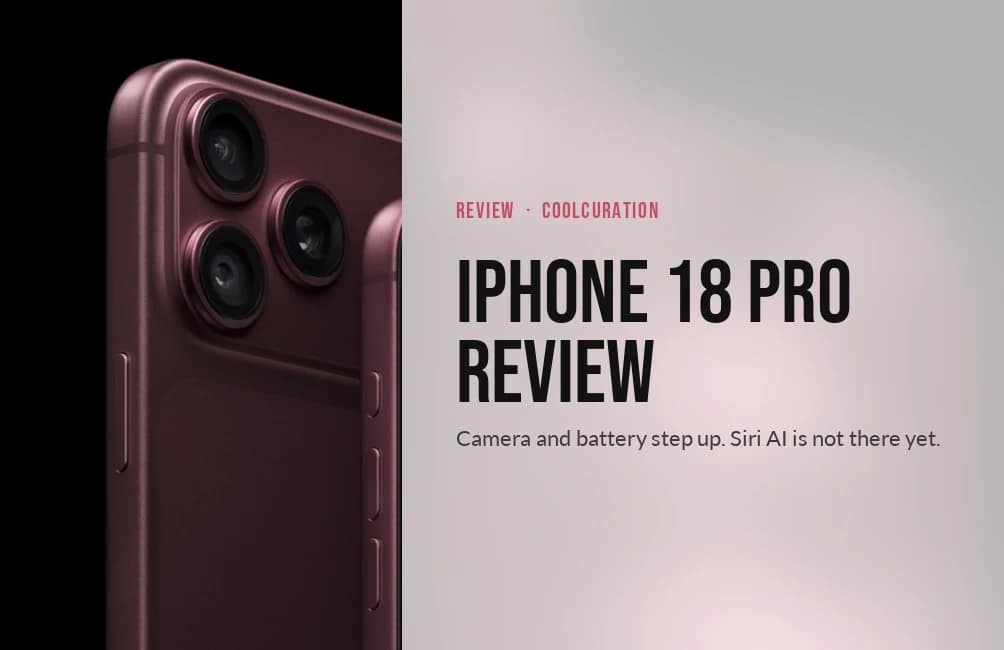
This iPhone 18 Pro review is an opinion piece and not professional advice. Prices, specifications and offers change, so check the retailer before you buy. This article contains affiliate and referral links; if you buy or sign up through one I may earn a commission or referral bonus at no extra cost to you. Cover image built from Apple's own press photograph of the iPhone 18 Pro.
What's trending




Recent posts
- Best Affordable Art UK 2026: 15 Prints and Originals Under £500
 Fifteen prints and originals under £500 from UK gallery shops, print studios and Saatchi Art, plus how editions, framing and Own Art work.
 - Apple Welcome Home Event: What It Means for Your UK Smart HomeApple Welcome Home event, UK view: HomeView, Apple TV 4K and HomePod mini 2 prices, release dates and the new LG cameras.
- iPhone Duo Pre-Order UK: Price, Timing and Whether to BotherThe iPhone Duo pre-order opens at 1pm UK time on 16 October. Every UK price, the case and folio, trade-in values, the eSIM catch and who should skip it.



No Comments.