
Last updated: 19 May 2026
By Tristan · Arts, exhibitions and creative culture
This is an opinion piece. Views expressed are the author's own and do not constitute professional advice.
This article contains affiliate or referral links. If you click through and sign up I may earn a commission or referral bonus at no extra cost to you. It does not affect my editorial view.
This Olivia Guillot Glasshouse review covers in between blinks, the debut London solo show from a French-British painter who has spent the last year on the Tracey Emin Artist Residency in Margate. The work is loud, confident and unmistakably alive. It is also, quite plainly, the start of something rather than the finished thing. So if you want to back a young painter early, this small Soho room is a good place to begin.
Cool Factor: 4/5
What is in between blinks at Glasshouse?
in between blinks is Olivia Guillot's first solo show in London, on view at Glasshouse Projects, 5 Warwick Street, from 29 April to 13 June 2026. It debuts a series of new oil paintings made entirely during her time at the Tracey Emin Artist Residency at TKE Studios in Margate. Born in 2001 and only a year out of the University of Brighton, Guillot is exactly the kind of early-career painter Glasshouse exists to spotlight.
Every canvas in the room is large scale, with the low humdrum at 195 by 155 centimetres setting the upper end. Hot colour dominates throughout, with greens, yellows and saturated reds doing most of the heavy lifting. There is one force-of-attention picture, several quieter explorations and a sense, throughout, of a painter pushing hard at her own surfaces. So this Olivia Guillot Glasshouse review is not about a single masterpiece. Instead it is about a body of work hanging together, just.
Glasshouse, Gathering and an unfussy room in Soho
Glasshouse Projects is the project space attached to Gathering, the Soho gallery founded in 2022 with an inaugural exhibition by Turner Prize-winning artist Tai Shani. While Gathering itself shows blue-chip and mid-career names, Glasshouse exists to give a foothold to artists at the very beginning of their public lives. So a solo here is significant. In commercial-gallery terms, it is a proper London debut.
The room itself is small and uncomplicated, with a viewing-room feel rather than a temple-of-art air. That serves Guillot's work well. There is no theatre to compete with, just paintings, walls and you. However, the simplicity also exposes any weakness in the pictures, since nothing else is doing the talking. To Guillot's credit, the show holds the room. It does not feel undersized or over-stretched, and the hang is calm enough to let each canvas breathe. For a first solo, that alone is a small triumph.
From Brighton to Margate: the TEAR residency context
Guillot is part of the recent intake on the Tracey Emin Artist Residency, run from TKE Studios in Margate by the Tracey Emin Foundation. The TEAR programme has, in just a few years, become one of the most-watched residencies in the UK, both for the calibre of artists it picks up and for Emin's own outsized cultural pull. Anyone curious about the wider Emin universe should also see our review of A Second Life at Tate Modern, since the Margate residency carries a clear echo of her own painterly-personal voice.
Margate matters here. Several of these canvases respond to coastal walks, electricity pylons and the low background hum of a town where industrial infrastructure meets Turner-era light. Furthermore, Guillot has not just lived in Margate. She co-curated The Shape of Where as part of Off Season, the town's artist-led festival, and has shown in This Is Love and The Salon Show at TKE Studios over the last twelve months. So she is embedded, not parachuted. That shows, quietly, in the paint.
First impressions: hot colour, real heat
You walk in and the colour hits you first. There is no easing in, no gentle on-ramp. This Olivia Guillot Glasshouse review begins where the show begins, with the low humdrum, a picture that sits in the room like a lit match. The other canvases around it pick up the temperature rather than cooling it. For a small Soho space, the show runs hotter than expected.
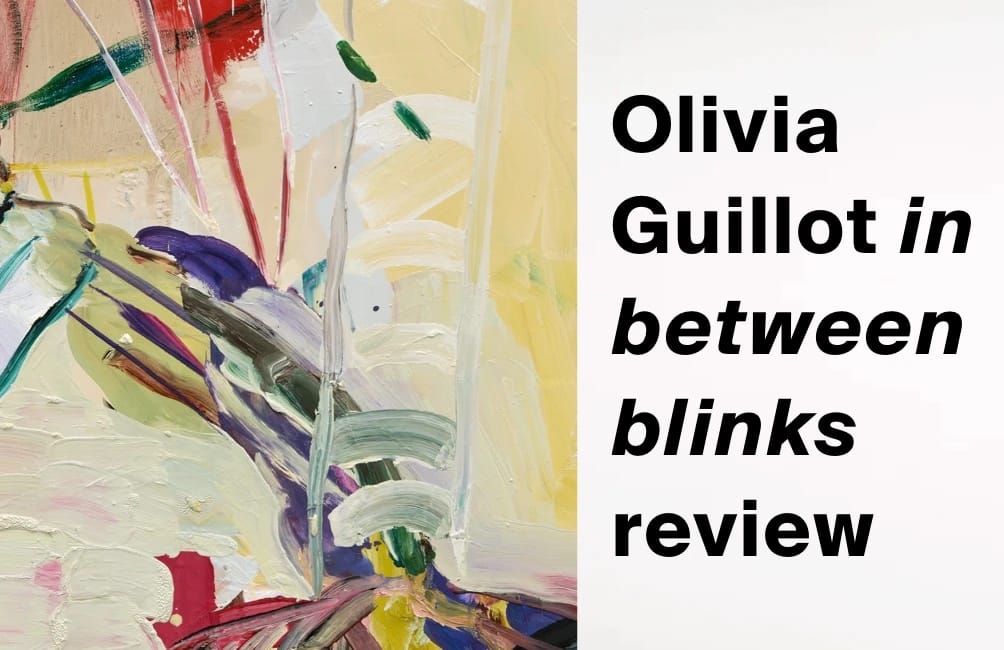
The mark-making, similarly, is unembarrassed. Guillot is plainly enjoying paint as paint. There is dripping, dragging, scrubbing and scratching. There are also areas where the canvas has been worked back into until earlier colour glows up from underneath, and other passages that look almost laid down in one breath. Some gestures are a touch show-offy, but most are confident in the right way. After the cautiousness that marks a lot of recent graduate painting, that confidence is genuinely refreshing.
Crucially, the surfaces feel built rather than decorated. You can read the order of marks. You can see what was put down, partly removed and reasserted. Consequently the pictures keep working at you for longer than they have any right to, given how recent and how unproven the painter is.
the low humdrum: pylons, paint and a saturated red
The headline canvas is the low humdrum, oil on canvas, 195 by 155 centimetres, dated 2026. A glassy, saturated red field flattens the picture into something that reads almost like a film still. Across that red, dark vertical lines drip from the top edge like wires losing tension. A dense, woven net of colour gathers in the lower right corner, and a single sweeping pale arc cuts through the upper half. There is a lot going on, but the red is the engine. Everything else is wired into it.
The starting point is, of all things, an electricity pylon. Guillot has spoken about being bewitched by these structures and the sense that they are alive. In the show's text she explains, "I become bewitched by things like pylons, emitting energies in their lines, their textures, wires, the low humdrum of the electricity passing through them, animating them as though they were alive, creatures of the landscape." What is clever here is that the pylon never appears as an object. The picture translates the hum, not the silhouette. So you get the energy without the diagram.
The picture works. It does not feel like a student exercise in scale, which is a common trap for big debut canvases. The red is doing more than just shouting, and the dripping verticals plus the net of woven mark-making give the field its spine. So for anyone reading this Olivia Guillot Glasshouse review who can only see one thing, this is the one.
Thick low air lurks in my hair: the painter's archaeology
The other standout is Thick low air lurks in my hair, and it is the painting where the pylon finally surfaces as a shape rather than as a feeling. A tall, dusty-pink lattice rises through the centre of the canvas, banded with vertical red striations that unmistakably read as the trusswork of an electricity pylon. Below it, a horizontal wave of dark purple loops across the lower half like a dropped fence or a length of cabling. A field of olive and acid yellow surrounds the structure, with one strange flash of turquoise at the right edge.
This is, for me, where Guillot is at her most interesting. There is a real understanding of paint as time. Each layer carries information about what came before, and nothing is purely surface. Buried yellows surface in patches under the green, the way a memory of a colour might. The pictures she leaves alone too early can feel a touch thin. In contrast, the ones she has reworked, like this one, have density and earned weight.
You can also feel, in this canvas, the influence of place. The title alone evokes Margate's heavy, salt-laden coastal weather. Likewise, the pylon-as-figure standing in a green field reads as a very specific Kentish vernacular: edgeland, infrastructure, sea air. So Guillot is reaching for sensation rather than depiction, and on this canvas she gets there.
Painting as dancing: how Guillot actually makes the work
One of the most useful insights into the show comes from Guillot herself. She has said, "Painting is very similar to dancing, but instead of moving to sound frequencies you are dancing with frequencies of colour, texture, rhythm, surface, space and densities of shape and form." She paints to music, and the rhythm of the work shows it.
That dancing-to-paint approach is increasingly common among British painters of her generation, but Guillot uses it with real intent. The marks have tempo. Sometimes a painting holds a single sustained gesture, the way a dancer might hold a long line. Sometimes it breaks into staccato. Moreover, the better canvases here have the give-and-take of an actual performance, with phrases and pauses, rather than feeling like an unbroken outpouring.
It also explains the show's tonal range. Some pictures are quiet, almost private. Others are at full volume. That variety is welcome. A debut that hit the same note across every canvas would be exhausting, however technically able the painter. So Guillot has the wit to vary the room's pulse. For this Olivia Guillot Glasshouse review, that variety is half the reason the show holds together at all.
The Fadojutimi shadow: an honest reservation
Now for the genuine reservation, because no Olivia Guillot Glasshouse review is honest without it. Guillot is still finding her own painterly language, and the influences are visible. The most obvious is Jadé Fadojutimi. The dancing-while-painting process, the layered oil and oil-pastel-feeling marks, the gestural-into-figurative slippage, the bright saturated palette, the talk of "frequencies" and rhythm: it all reads from the same broad school.
That comparison is unavoidable, and Guillot is not the only painter of her generation in that orbit. Still, on a couple of the canvases here, the debt feels heavier than the original voice. A few marks read as borrowed shorthand rather than genuine discovery. In other words, you can sometimes spot the homework before you spot the artist.
However, this is not a fatal flaw. It is the very normal noise of a painter at the start of a career, working publicly through her sources. The brightest canvases in the room, particularly the low humdrum, already begin to break free of the influence and find something Guillot-shaped. So the reservation is real, but it is also a problem on its way to being solved. That distinction matters.
Why a young painter at Glasshouse matters now
Beyond the work itself, this Olivia Guillot Glasshouse review sits inside a wider conversation about how new painters get a public start in the UK. The London commercial scene has narrowed. Project spaces close, rents bite, and the leap from graduate show to first solo is steeper than it has been in years. Therefore a programme like Glasshouse, which carries the underwriting of a serious gallery while taking on artists at the earliest stage, genuinely matters.
It matters for Guillot too. A first solo at a Soho address with curatorial backing is different from a first solo in a borrowed warehouse. There is a record. There are install shots. There is press attention, however modest. Furthermore, the link between Glasshouse and the TEAR residency creates a pipeline that British painting has historically lacked: a route running from art school, through a serious-money residency, to a London debut.
For collectors and curious viewers, the upshot is simple. If you want to see who might matter in five years, this is the kind of room to be in. The hits and misses are out in the open. The painter is still making her decisions in public. Honestly, that is part of the appeal.
How to see Olivia Guillot at Glasshouse
The exhibition runs at Glasshouse, 5 Warwick Street, London W1B 5LU, until 13 June 2026. Hours are Wednesday to Saturday, midday until 6pm. Entry is free, which means there is genuinely no excuse to skip it if you are passing through Soho. The room is small enough to see properly in twenty minutes and rich enough to repay forty.
If you want to keep going on a day of London painting, the show pairs well with bigger institutional outings nearby. Our V&A East review covers a useful counterpoint at the other end of the cultural register. Frequent gallery-goers may also want to look at our coverage of the National Art Pass, which pays for itself quickly if you are visiting more than a handful of paid shows a year. Either way, treat this Olivia Guillot Glasshouse review as a starting point and the pictures themselves as the answer.
The verdict
Cool Factor
★★★★☆
4 out of 5 Stone cold
A confident, hot-coloured debut from a painter with a long runway ahead. the low humdrum is the picture worth the trip on its own, and Thick low air lurks in my hair backs it up with quieter, more layered intelligence. The reservation, namely a still-visible debt to a particular school of British abstract painting, is real but solvable. So the score is 4 out of 5: properly impressive, well worth your time, and not quite Ice cold yet.
Closing summary
Overall, this Olivia Guillot Glasshouse review lands at a solid 4 out of 5 Stone cold. The show announces a painter with genuine confidence, a real instinct for colour and a feeling for paint as memory rather than just surface. It does not yet hit Ice cold because the language Guillot is forming has visible parents, and you can still hear them in the room. However, the strongest canvases are already beginning to speak in her own accent. File her, then, under "one to watch": come for the colour, stay for what she might paint next year.
Frequently asked questions
Where is the Olivia Guillot Glasshouse exhibition?
The show in between blinks is at Glasshouse, 5 Warwick Street, London W1B 5LU. Glasshouse is the project space of Gathering, the Soho gallery founded in 2022.
When does in between blinks close?
The exhibition runs until 13 June 2026. Opening hours are Wednesday to Saturday, midday until 6pm. Entry is free.
Is the Olivia Guillot Glasshouse review show worth visiting?
Yes, particularly if you follow emerging British painting. The work is bold, well-made and sits inside a wider story about the Tracey Emin Artist Residency. We rated it 4 out of 5 Stone cold.
What is the Tracey Emin Artist Residency?
TEAR is the residency programme run by the Tracey Emin Foundation from TKE Studios in Margate. It supports early-career artists with studio space and mentoring. Olivia Guillot has been on the residency since 2025.
Where did Olivia Guillot study?
Guillot graduated from the University of Brighton in 2024. Her first solo show, Swallowed a Fly, was held at Phoenix Art Space in Brighton the same year.
Who does Olivia Guillot's painting remind you of?
The closest stylistic comparison is Jadé Fadojutimi, particularly in the gestural mark-making, the dancing-to-paint process and the saturated colour. Guillot is still finding her own voice, but the lineage is clear.
What does this Olivia Guillot Glasshouse review rate the show?
4 out of 5 Stone cold on the CoolCuration Cool Factor scale. Properly impressive, well worth visiting, with one honest reservation about a still-forming voice.
More from CoolCuration
- Katharina Grosse at White Cube review, for another bold colour-led painting show worth your time.
- Gifts for artists and creatives, if Guillot's room left you itching to make something yourself.
- Rose Wylie Study for Red Twink print, affordable contemporary art from a fellow British painter who loves loud colour.
- theprintspace discount code, useful for printing your own work or framing prints from artists you spot early.
- Rick Rubin: The Creative Act, the best recent book on making things despite uncertainty.
- Christine Kozlov at Raven Row review, a quieter London painting-adjacent show for your next gallery day.
What's trending




Recent posts
- Premium Bonds Alternatives UK 2026: Prize Savings Accounts Compared
 Four Premium Bonds alternatives open to new savers, with each provider's published odds, prize tables, access rules and protection.
 - Best Audiobooks October 2026: 10 UK Listens RankedTen new audiobooks for October 2026, from a full-cast Dracula with Jonathan Bailey to Russell T Davies reading his own television memoir.
- Louis Fratino at David Zwirner ReviewLast updated: 4 October 2026 By Tristan · Arts, exhibitions and creative culture This is an opinion piece. Views expressed are the author's own and do not constitute professional advice. Exhibition reviewMayfair Saunas, subway cars and a lot of skin in Mayfair Louis Fratino at Zwirner is the American painter's first solo show in London,… Read more: Louis Fratino at David Zwirner Review


No Comments.