
Last updated: 13 October 2026
By Stiv · Design, technology and personal finance
I've used Sprive since October 2021, making monthly overpayments on my mortgage through the app. This comparison is based on that real use alongside Chip and Plum.
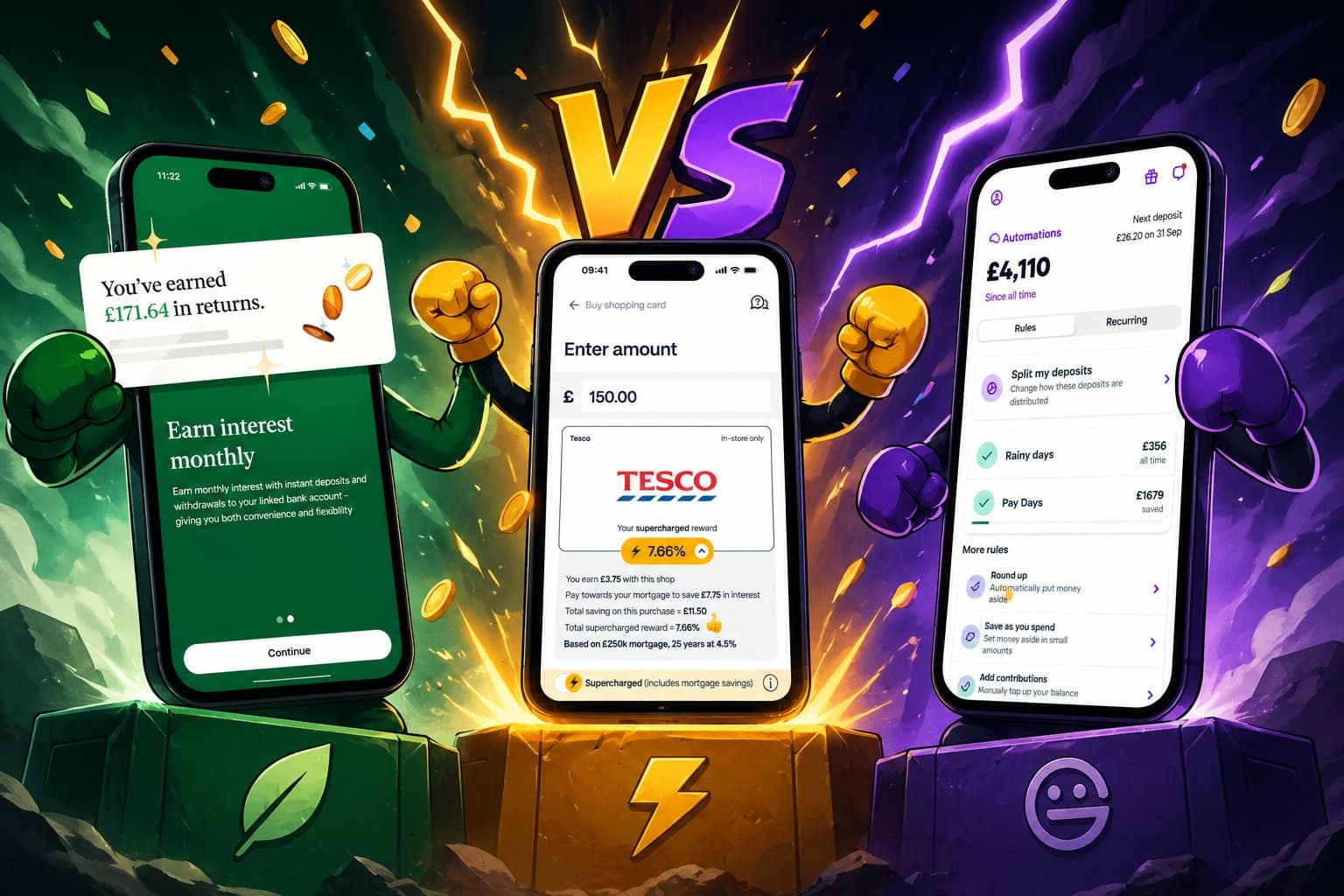
Sprive vs Plum vs Chip is the question that keeps coming up whenever anyone in the UK talks about saving money automatically. All three apps promise to do the hard bit for you. But they are not the same thing, and picking the wrong one means you are either missing features you need or paying for ones you do not. Here is how they actually compare after months of using all three.
Between the team, we run all three. Sprive handles mortgage overpayments. Chip is our primary auto-saver. Plum runs alongside Chip so we can see how the two compare in real life. Each has earned its place on someone's home screen, but for very different reasons.
This article is for informational purposes only and does not constitute financial advice. Some apps in this comparison offer investing features, which carry risk including the possible loss of capital. Your home may be repossessed if you do not keep up repayments on your mortgage. CoolCuration is not authorised by the Financial Conduct Authority. This article contains affiliate and referral links, which are paid links. If you click one and buy or sign up, I earn a commission or referral bonus at no extra cost to you. Brands don't choose what I feature or what I say about them.
Sprive's current sign-up offer
If Sprive ends up being your pick of the three, the latest welcome bonus is always on our referral page.
Comparing money apps? The three-way verdict is below. For everything we have written on Sprive in one place, see our Sprive guides hub.
What each app actually does
Before we get into the side-by-side detail, here is a quick summary of what you are actually picking between.
Sprive
Sprive is a mortgage overpayment app. It analyses your spending, sets aside spare cash, and routes it directly to your lender as an overpayment. You also earn cashback through in-app gift cards, which feeds straight into your mortgage pot. It is not a general savings app and it does not invest. If you do not have a mortgage, Sprive simply is not for you. Our full Sprive review goes deeper on the day-to-day experience.
Chip
Chip is an auto-saving app. It analyses your spending, moves affordable amounts into a savings account every four days, and offers Prize Saver (a Premium Bonds-style draw), an Instant Access account, a Cash ISA, and basic investing through funds and a Stocks and Shares ISA. Clean, simple, and focused.
Plum
Plum is an auto-saving app with extras. It does everything Chip does, plus round-ups, a 95-day notice pocket, more investment options, a Lifetime ISA, a SIPP, and bills management. More features, but a busier app.
The first thing to understand: Sprive is in a different category. Chip and Plum are the direct competitors. So when someone asks us "Sprive vs Plum vs Chip", we usually break it into two questions: do you have a mortgage, and which auto-saver fits your style?
Sprive vs Plum vs Chip: the comparison table
| Feature | Sprive | Chip | Plum |
|---|---|---|---|
| Auto-saving | Yes (to mortgage) | Yes | Yes |
| Round-ups | No | Limited | Yes |
| Mortgage overpayments | Yes (core feature, 14 supported lenders) | No | No |
| Cash ISA | No | Yes (4.60% boosted) | Yes (4.26% boosted) |
| Easy access savings | No | Yes (3.81% new boost) | Yes (varies by plan) |
| Prize draw account | No | Yes (Prize Saver) | No |
| Investing | No | 40+ funds, S&S ISA | 3,000+ stocks, 26 funds, SIPP, LISA |
| Cashback | Yes (Sprive assumes ~4% average) | No | Yes (in-app offers) |
| Free tier | Fully free | Free (45p per autosave may apply) | Free (Basic) |
| Premium tier | N/A | ChipX £5.99 / 28 days | £3.99 to £14.99 per month |
| FSCS protection | No (wallet is safeguarded e-money via PrePay Technologies, not FSCS) | £120,000 (via ClearBank) | £120,000 (Investec for pockets; a bank panel for the Cash ISA) |
| Referral offer | Mortgage credit (amount confirmed in-app) | £50 (deposit £1,000, hold 90 days) | Referrer-only |
Chip, Plum and Sprive figures all read on each provider's own site on 10 September 2026. All subject to change. FSCS deposit protection is shared across all accounts held with the same partner bank.
The detail: Sprive vs Plum vs Chip head to head
Auto-saving algorithm
All three apps connect via Open Banking, read your transactions, and work out an amount you can afford to set aside. The mechanics are similar, but the experience differs.
Chip saved more consistently for us over three months side by side. Plum was more aggressive at the start and we had to dial it back to stop it pulling more than felt comfortable. Sprive's auto-overpayment is a different beast entirely because it targets your mortgage rather than a savings pot.
If you struggle with discipline, any of these will help. However, Chip's algorithm felt the most "background" once it was set up. Plum's wanted more attention.
Round-ups
Plum wins this one cleanly. Round-ups feel native to the app and added roughly £30 to £40 per month for us without us noticing. Chip does offer round-ups, but the implementation feels less seamless. Sprive does not do round-ups in the traditional sense at all.
If round-ups are the feature you want, Plum is the obvious pick.
Interest rates and savings
This is where the numbers matter. The Chip figures below were read on Chip's own site on 10 September 2026. The Plum and Sprive figures were read on their own sites the same day.
Chip's Instant Access account pays 3.51% AER for new customers as a 12-month boosted rate, then drops to 3.00%. The old Chip Cash ISA is closed to new customers, and the Smart Cash ISA that replaced it pays 4.60% AER boosted for twelve months, falling to 3.50% after Chip cut the underlying rate from 3.75% on 10 September 2026. Both are variable trackers linked to the Bank of England base rate.
Plum's Cash ISA pays 4.26% AER for new customers, Plum's rate from 24 August 2026, but that headline includes a 1.72% bonus that disappears after 12 months. The underlying rate is 2.54%. The easy-access pockets pay lower rates that vary by plan tier, and the best notice-pocket rate sits on the top Max tier.
Plum's headline rates look better, but they are tier-locked or bonus-loaded. Chip's look slightly lower but apply across the board on the free plan. Honestly, neither will beat a top-of-market easy access account if you are willing to chase rates manually. For more on that, see our traditional savings account comparison.
Then there is Chip's Prize Saver, officially the Prize Savings Account, which is its unique differentiator. Instead of paying interest, it enters you into a monthly prize draw: every £10 of average balance buys one entry, and September 2026 has a £10,000 grand prize and 15,020 smaller ones. It is a gamble on the return rather than the capital, so you can hold it for a year, win nothing, and end up behind inflation. We covered how Prize Saver compares to Premium Bonds in depth, and the short version is that it is more accessible than NS&I but with smaller prize pots.
Mortgage overpayments
Sprive is the only one of the three that does this. Sprive is well worth exploring if you have a mortgage and want to automate overpayments.
The point worth emphasising is that Sprive is not actually competing with Chip or Plum. It is complementing them. We run Sprive AND Chip together. One handles the mortgage. The other handles the rainy-day savings. They do completely different jobs.
Sprive works with most major UK lenders including Nationwide, Halifax, HSBC, Santander, Barclays, NatWest, Lloyds, TSB, Virgin Money, Yorkshire Building Society, and Coventry Building Society. For more on the practical side, our mortgage overpayment guide covers the full picture, and how Sprive's cashback works explains the gift card mechanic in detail. Always check your lender's overpayment terms before going hard, since most allow up to 10% of the outstanding balance per year before triggering early repayment charges.
Sprive Limited (FRN 919863) is an appointed representative of Connect IFA Ltd (FRN 441505) and New Leaf Distribution Limited (FRN 460421), both authorised and regulated by the Financial Conduct Authority; verify on the FCA register. Money in the Sprive wallet is held by PrePay Technologies Ltd (FRN 900010) as safeguarded e-money, not FSCS-protected. Your home may be repossessed if you do not keep up repayments on your mortgage.
Investing
Plum has the most investing options of the three. It offers up to 3,000 stocks (depending on plan), 26 funds, a Stocks and Shares ISA, a Lifetime ISA, a SIPP, and Plum Interest (a money market fund). Chip offers a more limited spread: 40-plus funds, a General Investment Account, and a Stocks and Shares ISA. Sprive does not offer investing at all.
Honestly, we would use a dedicated platform for serious investing. Neither Chip nor Plum compete with Freetrade or Lightyear on fees, fund range, or interface for active investors. The investing features here are best thought of as convenient extras rather than the main event.
Capital at risk. The value of investments can go down as well as up and you may get back less than you invested. Past performance is not a reliable indicator of future results. Tax treatment depends on the individual circumstances of each client and may be subject to change in future.
The app experience
Chip is clean, simple, and calming. It does less, but does it better. Opening the app feels low-stakes.
Plum is busier. More features, more upsell prompts, more pockets, more pop-ups about premium tiers. Feature-rich but cluttered. We always choose simplicity, which is why Chip ended up as our primary and Plum stayed as the backup.
Sprive is focused entirely on the mortgage. There are no distractions, no investment prompts, no pretending to be a current account. You open it, you see your mortgage balance, you tap to overpay. That single-purpose focus is exactly what makes it work.
Free vs premium tiers
Sprive is fully free. There is no premium tier and no subscription nag.
Chip is free to download, but the basic plan applies a 45p fee per autosave on certain account types. ChipX (£5.99 per 28 days) removes those fees and unlocks the full investment fund range. For most casual savers, the free plan is fine.
Plum has four tiers: Basic (free), Plus (£3.99), Boost (£7.99), and Max (£14.99) per month. The free tier covers the basics including auto-save, round-ups, the Cash ISA, and one customisable pocket. Anything more (extra pockets, the Plum debit card, the 95-day notice rate, more funds, lifestyle perks) is paywalled. The free tier is perfectly usable, but Plum clearly wants to push you up the ladder.
Honestly? We have not paid for any premium tier across these apps. The free versions do enough for most people.
Cashback
Sprive's cashback is the best of the three because it is direct and purposeful. You buy gift cards inside the app for places you already shop (Tesco, Sainsbury's, M&S, Just Eat and so on), earn cashback that Sprive's own calculator assumes averages 4%, and Sprive credits that cashback to your account the moment you buy the card, which in my experience lands within about 15 minutes, ready to send to your lender with one tap. Boring, useful, and frictionless.
Plum has cashback offers within the app too, but they feel like a side feature rather than a core mechanic. Chip's cashback is limited and not really what you would download the app for.
So which should you download?
Here is the verdict, broken down by who you are.
If you have a mortgage: Sprive plus Chip is worth considering. Sprive handles overpayments. Chip handles savings. They do not overlap.
If you want set-and-forget simplicity: Chip may suit those who prefer simplicity. Clean app, solid algorithm, Prize Saver as a fun bonus.
If you want the most features in one place: Plum suits those who want more features in one place. Auto-saving, round-ups, investing, bills management, ISAs, all under one roof.
If you want round-ups specifically: Plum. Their implementation is the best of the three.
If you want all three: Go for it. They do not conflict. We run all three and they complement each other.
Using our Plum link supports the site at no cost to you. Plum's referral programme rewards the referrer rather than offering a guaranteed sign-up bonus to new users. Chip's £50 bonus requires depositing £1,000 and holding it for 90 days. Sprive's own referral policy says the reward varies by campaign and that some campaigns pay nothing, so treat any Sprive welcome credit as a maybe. Sprive and Chip bonuses are set by each provider and subject to change.
For more context, our full Sprive review, full Chip review, and full Plum review all go deeper on each app individually. You can also browse independent comparisons over at MoneySavingExpert and check the apps directly via Sprive, Chip, and Plum.
This article is for informational purposes only and does not constitute financial advice. Some apps in this comparison offer investing features, which carry risk including the possible loss of capital. Capital at risk: the value of investments can go down as well as up and you may get back less than you invested. Past performance is not a reliable indicator of future results. Tax treatment depends on the individual circumstances of each client and may be subject to change in future. Rates can change, and the FSCS protects eligible deposits up to £120,000 per person per banking licence (effective December 2025). Your home may be repossessed if you do not keep up repayments on your mortgage. Always check current terms and consider speaking to an independent financial adviser before making decisions. Some links above are referral links which support the site at no cost to you.
FAQs
Is Chip better than Plum?
For us, yes, but only because we prioritise simplicity. Chip's app is calmer, the autosave algorithm is steadier, and the Prize Saver is a nice extra. Plum has more features and round-ups, so if you want everything in one place, it has the edge. There is no objectively right answer.
Is Sprive worth it for mortgage overpayments?
If you struggle to make overpayments consistently, yes. Sprive removes the friction of remembering and transferring manually. The cashback feature is also a real win because you are turning shopping you would do anyway into mortgage progress. Just check your lender's overpayment limits first.
Can I use Sprive and Chip together?
Absolutely. We run both. Sprive handles the mortgage. Chip holds rainy-day savings. They connect to your bank independently and do not interfere with each other.
Which auto-saving app saves the most?
Plum tends to be more aggressive out of the box, while Chip is steadier. Over three months, Chip saved more for us simply because Plum's higher pulls made us reduce its limits. But you can dial either app up or down to match your comfort level.
Is Plum or Chip better for round-ups?
Plum, by some margin. Round-ups feel native to the app and add a noticeable amount over the month. Chip does offer round-ups but the experience is less seamless.
Do I need a mortgage to use Sprive?
Yes. Sprive is built around mortgage overpayments, so without a mortgage there is nothing for the app to do. If you do not have a mortgage, Chip or Plum will be far more useful.
Are Chip and Plum safe?
Both are FCA-authorised. Eligible deposits in Chip's savings accounts are protected by the FSCS up to £120,000 via partner bank ClearBank. Plum's Easy Access pockets are held with Investec Bank, and its Cash ISA with a panel of banks Plum names as Citibank, Lloyds, Qatar National Bank, BBVA and Nationwide, each FSCS-protected up to £120,000 per person per bank. Investments held with either are covered by the FSCS investor compensation scheme up to £85,000.
Which app has the best interest rate?
Chip's Smart Cash ISA now pays 4.60% AER boosted for twelve months, checked 10 September 2026, which puts it ahead of Plum's 4.26% AER, read the same day. Both headlines include a 12-month bonus and both drop afterwards, Chip to 3.50% and Plum to 2.54%, so do not assume either applies forever. Always compare against the wider market before committing.
You might also like
- Sprive mortgage app review: our full verdict on Sprive from personal use since 2021.
- Chip referral code: the £50 bonus (deposit £1,000, hold 90 days) and how to claim it.
- Freetrade referral offer: a dedicated investing app worth a look if Plum's investing features feel limiting.
- Chip Prize Saver vs Premium Bonds: how the Prize Saver draw stacks up against the original.
- New home gift guide: practical and stylish picks for new homeowners.
- Best savings accounts UK: traditional savings comparison if you want to chase the top market rate.
What's trending






Recent posts
- Best Affordable Art UK 2026: 15 Prints and Originals Under £500
 Fifteen prints and originals under £500 from UK gallery shops, print studios and Saatchi Art, plus how editions, framing and Own Art work.
 - Apple Welcome Home Event: What It Means for Your UK Smart HomeApple Welcome Home event, UK view: HomeView, Apple TV 4K and HomePod mini 2 prices, release dates and the new LG cameras.
- iPhone Duo Pre-Order UK: Price, Timing and Whether to BotherThe iPhone Duo pre-order opens at 1pm UK time on 16 October. Every UK price, the case and folio, trade-in values, the eSIM catch and who should skip it.



No Comments.