
Last updated: 17 September 2026
By Stiv · Design, technology and personal finance
I have a Nationwide mortgage and have paid an extra £100 a month into it through Sprive since October 2021, so every one of these decisions lands on my own kitchen table. Nearly five years of that sits behind this page.
This article contains affiliate or referral links. If you click through and sign up I may earn a commission or referral bonus at no extra cost to you. It does not affect my editorial view.
This is not financial advice. CoolCuration is not authorised or regulated by the Financial Conduct Authority. Rates and offers change often, so check the provider’s own terms before you act.
Your home may be repossessed if you do not keep up repayments on your mortgage.
Overpaying while the rate sits still?
I keep the current Sprive welcome offer and the steps to claim it up to date on my referral page.
Bank of England base rateSeptember 2026
Held at 3.75%. Three of nine wanted it higher.
The Bank of England base rate stays at 3.75%. The Monetary Policy Committee voted 6 to 3 to hold it on Thursday 17 September 2026. But the three who broke ranks did not want a cut. Megan Greene, Catherine Mann and Huw Pill voted to raise it to 4%, for the second meeting running. So this is less a pause than a stand-off, and your mortgage, your savings and your energy bill all sit on one side of it.
Section 01 · The decisionWhere the Bank of England base rate stands now
3.75%, unchanged since December 2025, on a 6 to 3 vote.
The Bank of England base rate, which the Bank itself calls Bank Rate, is the rate it pays on reserves held by commercial banks. In practice it sets the floor for what lenders charge and what savers earn. The Monetary Policy Committee has nine members, and they vote on it eight times a year.
Six members voted to hold at the meeting that ended on 16 September. They were Andrew Bailey, Sarah Breeden, Swati Dhingra, Clare Lombardelli, Dave Ramsden and Alan Taylor. Meanwhile Megan Greene, Catherine Mann and Huw Pill voted for a quarter-point rise to 4%. That is the same split, with the same three names, as July. Bank Rate itself has not moved since it was cut from 4% on 18 December 2025.
| Announced | Vote to hold at 3.75% | The dissent |
|---|---|---|
| 5 February 2026 | 5 to 4 | Four wanted a cut to 3.5% |
| 19 March 2026 | 9 to 0 | None |
| 30 April 2026 | 8 to 1 | One wanted a rise to 4% |
| 18 June 2026 | 7 to 2 | Two wanted a rise to 4% |
| 30 July 2026 | 6 to 3 | Three wanted a rise to 4% |
| 17 September 2026 | 6 to 3 | Three wanted a rise to 4% |
Read down that table and the direction is clear. In February, for instance, the argument was about how soon to cut. Since April, the only votes against holding have been votes to raise, and their number has grown from one to three.
You can check every past decision on the Bank’s own Bank Rate history table. The full reasoning sits in the September 2026 Monetary Policy Summary and minutes. So that is where every quote below comes from.
Section 02 · The splitWhy three members wanted the base rate higher
Inflation went up, oil went up, and the Governor’s own words moved.
The trigger is inflation. The Office for National Statistics says prices rose 3.1% in the 12 months to August 2026, up from 2.9% in July. That is the Consumer Prices Index, the inflation measure the Bank targets. Specifically, transport made the biggest upward contribution, and motor fuels most of all. In fact, petrol averaged 161.3p a litre in August, the highest since November 2022. Against a 2% target, prices are rising more than half as fast again as the Bank wants.
The Bank, in turn, ties that straight to the Middle East. Its summary says protracted conflict in the Middle East has contributed to further increases in crude and refined energy prices
since July. It also says inflation is likely to rise further over coming quarters
. Mann also went further in her own statement, noting the Bank’s short-term forecast has inflation reaching somewhat over 4% early next year.
Meanwhile, Pill argued that a quarter-point rise now would send a clear signal that the committee means to get inflation back to target.
But the more telling line came from the majority. Andrew Bailey voted to hold, yet his own statement says that if the conflict persists for an extended period, as appears to be the case
, and higher energy costs spread into wider prices and pay, it is likely that policy may have to tighten
. In other words, rates would go up. So the Governor is on the hold side, and he has written down the conditions under which he would move.
The risk for energy prices, and thus inflation, continues to be on the upside.
Andrew Bailey, Governor, Bank of England minutes, September 2026The inflation miss also triggered an open letter from the Governor to the Chancellor, which the Bank published alongside the minutes. Indeed, by the Bank’s own count, inflation is 1.1 percentage points above target, and around 0.7 of those points come directly from energy prices.
Section 03 · MortgagesWhat a base rate hold does to your mortgage
Tracker payments stay put. Fixed rates moved anyway.
If you are on a tracker, nothing changes this month. A tracker follows the Bank of England base rate plus a set margin, so a hold leaves your payment where it was. Each lender sets its own standard variable rate, although it usually moves with Bank Rate too.
The swap rate problem. Fixed rates are a different story, because lenders price a fix off swap rates, which are the market’s bet on where Bank Rate goes over the next two or five years. So a fixed rate can rise while the base rate sits still. That is exactly what happened this month, and it is where most people get caught out.
On 15 September, two days before the decision, the rates data firm Moneyfacts reported that swap rates had climbed above 4.70%. As a result, its analyst Rachel Springall said NatWest, Santander, HSBC and TSB raised selected fixed rates for the second time in September. The Bank’s own minutes put the quoted rate on a two-year fix around 0.95 percentage points above where it stood before the conflict began.
For example, take a £200,000 repayment mortgage over 25 years. At 4.50% the monthly payment is about £1,112. Then add 0.95 points, to 5.45%, and it becomes about £1,222. That is roughly £111 a month more, for a remortgage that lands in the wrong month. My guide on when to remortgage covers how far ahead you can lock a deal in, which matters more when fixes are climbing.
Overpaying is the lever you actually control
Of course, you cannot move Bank Rate, and you cannot move swap rates. However, you can move your balance. Every pound you overpay stops charging interest from that day, and most lenders let you overpay up to 10% of the balance a year without an early repayment charge. Check your own lender’s limit first, because some are lower.
On that same £200,000 at 5.45%, an extra £100 a month would save about £27,750 in interest and clear the loan 43 months early, if the rate held for the whole term. Still, rates rarely hold that long, so treat that as the shape of the saving rather than a promise. My mortgage overpayment guide runs through the limits and the maths in full. Then the overpayment calculator takes your own numbers.
I do my £100 a month through Sprive, which schedules the overpayment to my lender and adds cashback from supermarket spending on top. Sprive Limited (FCA firm reference number, or FRN, 919863) is an appointed representative of Connect IFA Ltd (FRN 441505) and New Leaf Distribution Limited (FRN 460421). PrePay Technologies Limited (FRN 900010) holds money waiting in the Sprive wallet. That money is safeguarded, but it is not protected by the Financial Services Compensation Scheme (FSCS). Every Sprive guide I have written, from lenders to prize draws, sits on my Sprive guides page.
Your home may be repossessed if you do not keep up repayments on your mortgage.
Section 04 · SavingsWhat the base rate means for your savings
Your balance grows. What it buys may not.
Similarly, a hold means variable savings rates that track the base rate stay where they are for now.
The real-return gap. The catch is inflation. With inflation at 3.1%, any account paying less than that is losing spending power, even while the balance goes up.
Say £10,000 sits in an account paying 2%. After a year you have £10,200. Meanwhile, the same basket of shopping that cost £10,000 now costs £10,310 at 3.1% inflation. So you are £110 worse off in real terms, before any tax on the interest.
That is why the first job is to check the rate you are actually on. After all, old easy access accounts and current-account pots often pay far less than the base rate. For that reason I checked easy access, notice, regular saver, fixed bond and cash ISA rates at source for my best savings account guide. It names the bank behind each one.
Chip’s referral window
Chip is one of the apps I have covered in depth, in my Chip app review. I read Chip’s own referral terms on 5 October 2026. They show a promotion running from 1 October to 23:59 on 31 October 2026. A new customer who has never held a Chip account gets £50. To qualify, you first deposit at least £1,000 into an eligible Chip account. Then you keep £1,000 there for 90 days in a row, all within 120 days of being referred.
The eligible accounts are the Smart Cash ISA, Instant Access, Prize Savings, the General Investment Account and the Stocks and Shares ISA. However, two of those are investments. Capital at risk. The value of investments can go down as well as up and you may get back less than you invested. The Chip Cash ISA is closed to new customers, so it is not an option here.
ClearBank Limited (FRN 754568) holds Chip savings deposits. Eligible deposits are protected up to £120,000 per eligible person per UK-authorised bank, building society or credit union by the FSCS (since 1 December 2025). Anything else you hold at ClearBank also counts towards that limit. The £50 bonus itself is not FSCS protected. Chip is a trading name of Chip Financial Group Ltd (FRN 911255).
Section 05 · EnergyWhat it means for your energy bill
The price cap moves on its own timetable, not the Bank’s.
Unlike your mortgage, your energy bill does not follow Bank Rate. Instead, Ofgem sets it through the price cap, and the cap moved separately. From 1 October to 31 December 2026, Ofgem’s October cap announcement sets these average rates for direct debit customers.
| Fuel | Unit rate | Standing charge | VAT |
|---|---|---|---|
| Electricity | 26.32p per kWh | 54.83p per day | None, removed until 31 March 2027 |
| Gas | 7.97p per kWh | 29.68p per day | Included at 5% |
The VAT comparison problem. Ofgem calls it a 4% rise for a typical dual fuel household. However, the government has taken VAT off electricity from 1 October 2026 to 31 March 2027. As a result, Ofgem’s own page says costs cannot be compared directly to previous periods because of this change
. So you will see both 4% and 3.6% quoted. Meanwhile, the unit rates above are what suppliers actually charge you. My Ofgem price cap guide explains how the cap works. Beyond that, my October 2026 price cap breakdown has the regional detail.
At the same time, the energy prices that split the Bank’s committee have fed through to fixed energy tariffs too. So on 17 September I priced Octopus 12M Fixed from Octopus’s public tariff data, at Ofgem’s typical use. That version has been on sale since 11 September. It now sits £75 to £117 a year above the October cap, depending on region. By contrast, in late August the previous version sat below the cap everywhere. I have added the new figures to my guide to whether you should fix your energy tariff.
Ofgem announces the next cap, for January to March 2027, on 25 November 2026. If you are switching supplier anyway, Octopus gives a new customer £50 of account credit through a referral link. The credit arrives once the switch completes and Octopus has taken the first direct debit. Octopus is regulated by Ofgem as an energy supplier, not by the FCA.
See the Octopus referral offer
Section 06 · What nextWhen the base rate is decided next
Two more decisions this year, and I will update this page after each.
| Date | What happens |
|---|---|
| Thursday 5 November 2026 | Bank of England rate decision, with its November Monetary Policy Report |
| Wednesday 25 November 2026 | Ofgem announces the January to March 2027 price cap |
| Thursday 17 December 2026 | Bank of England rate decision |
The Bank lists its dates for upcoming rate decisions well ahead. For 2027 the provisional dates are 4 February, 18 March, 29 April, 17 June, 29 July, 16 September, 4 November and 16 December.
As for what markets expect, the Bank’s own minutes give two readings. First, nearly everyone in its September survey of market participants expected a hold this month and a long run of holds after it. That survey closed on 4 September. Since then, however, the interest rates that markets are pricing in for the months ahead have risen further, peaking at around 4.9% by the end of 2027. The Bank also says its market intelligence showed the perceived chance of a near-term rise had gone up.
Those are the markets’ expectations, as reported by the Bank on 17 September 2026. I am not going to guess the next move. Instead, I will update this page after each decision.
Bank of England base rate FAQs
What is the Bank of England base rate right now?
It is 3.75%. The Monetary Policy Committee held it there on 17 September 2026, by six votes to three. It has been 3.75% since 18 December 2025, and the next decision is on 5 November 2026.
Why did mortgage rates go up when the base rate did not?
Because fixed rates follow swap rates, not the base rate. Swap rates, meanwhile, reflect where markets think Bank Rate is heading. Moneyfacts reported swaps above 4.70% on 15 September 2026, and four of the biggest lenders raised fixes twice in September as a result.
Should I fix my mortgage now?
That depends on your deal, your deadline and how much a payment rise would hurt, so it is a question for a qualified broker. Still, most mainstream mortgage offers last around six months. So you can often secure a rate early and switch if something cheaper appears. My guide to paying off a mortgage faster covers the moves that work whichever way rates go.
What does a base rate hold mean for my savings?
Variable rates that track Bank Rate stay put for now. With inflation at 3.1%, though, any account paying less than that loses buying power. So check the rate you are actually on, because older accounts often pay well below the base rate.
Does the base rate affect my energy bill?
Not directly. Ofgem sets the price cap every three months, and it announces the next one on 25 November 2026. However, the energy prices behind the Bank’s decision also push up the cap and the price of fixed energy tariffs.
When is the next Bank of England base rate decision?
Thursday 5 November 2026, at 12:00, followed by Thursday 17 December 2026. I update this page after each one.
More from CoolCuration
- How to read an energy bill: find your tariff, your usage and how you pay, all on one statement.
- The mortgage app from Dragons’ Den: how Sprive got its start, and what it does for an overpayer.
- Chip app: the factual record of what Chip offers and who regulates each part.
- New home gift guide: for anyone who has just got the keys and a new mortgage with them.
- Energy switching offers: current sign-up deals across suppliers, in one place.
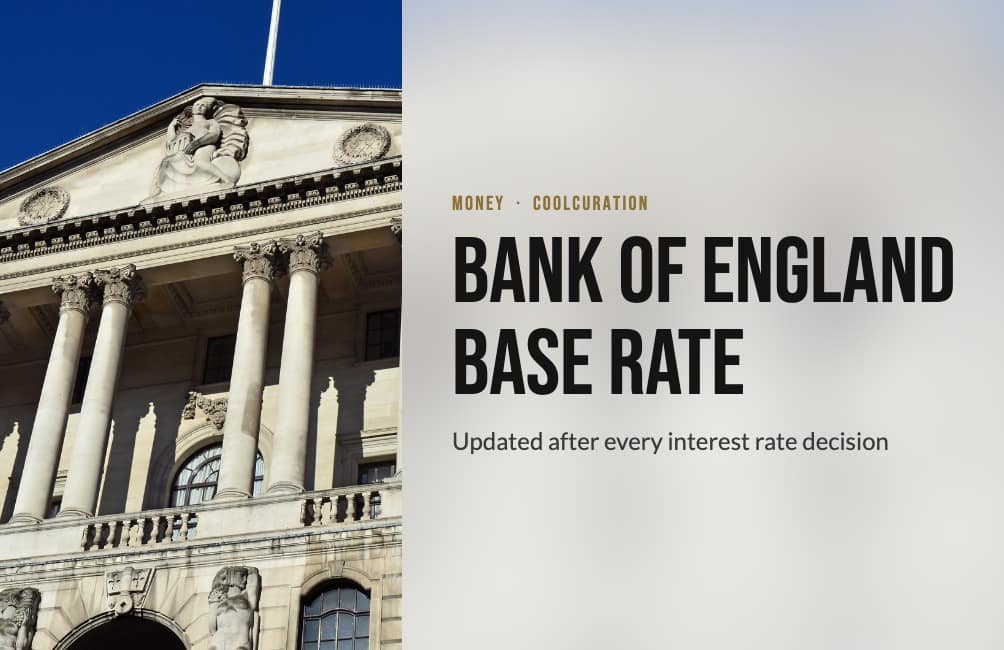
Disclaimer: rates, offers and terms change often, and every figure here was checked at source on 17 September 2026. Nothing in this article is financial advice, and CoolCuration is not authorised or regulated by the FCA. Consider speaking to a qualified adviser or mortgage broker about your own circumstances. Your home may be repossessed if you do not keep up repayments on your mortgage. Capital at risk where investments are mentioned. Finally, this article contains affiliate or referral links. If you click through and sign up I may earn a commission or referral bonus at no extra cost to you. It does not affect my editorial view. Featured image: Bank of England, Threadneedle St. by Images George Rex, CC BY-SA 2.0, cropped, blurred and overlaid with text.
What's trending






Recent posts
- Best Audiobooks October 2026: 10 UK Listens Ranked
 Ten new audiobooks for October 2026, from a full-cast Dracula with Jonathan Bailey to Russell T Davies reading his own television memoir.
 - Louis Fratino at David Zwirner ReviewLast updated: 4 October 2026 By Tristan · Arts, exhibitions and creative culture This is an opinion piece. Views expressed are the author's own and do not constitute professional advice. Exhibition reviewMayfair Saunas, subway cars and a lot of skin in Mayfair Louis Fratino at Zwirner is the American painter's first solo show in London,… Read more: Louis Fratino at David Zwirner Review
- What Is a Sprive Boost? Seven Days, and What It Actually PaysA Sprive boost lifts your cashback rate for seven days, and it arrives on its own. What mine paid, and why Supercharge is a display toggle rather than extra cashback.


No Comments.