
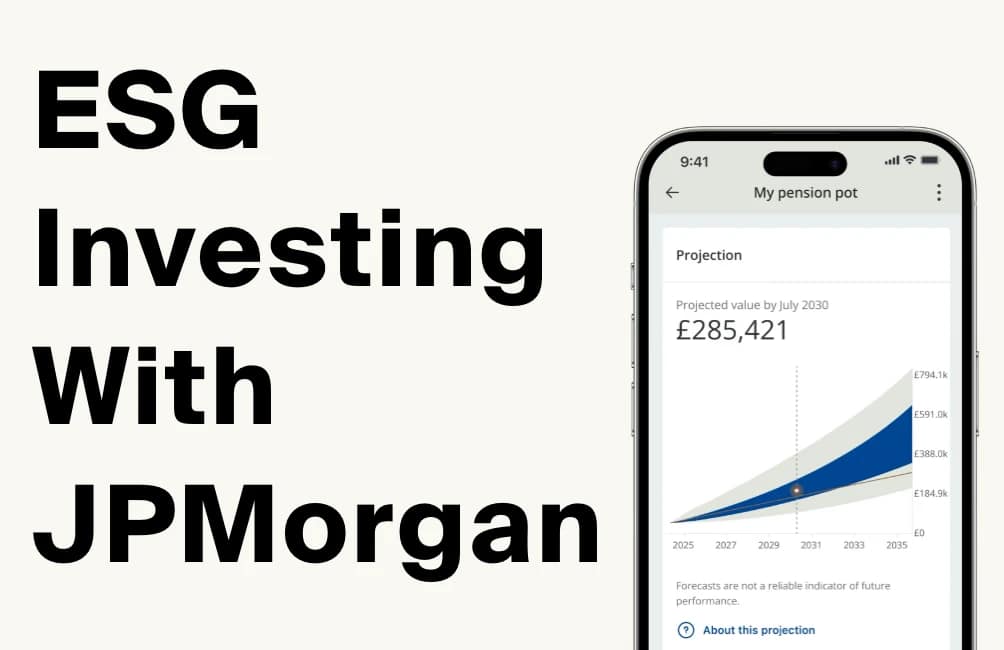
Last updated: 26 October 2026. I updated the MSCI scores, holdings, returns and fossil fuel figures in this ESG investing JPMorgan review.
By Stiv · Design, technology and personal finance
This is an opinion piece. Views expressed are the author's own and do not constitute professional advice.
Cool Factor: 3/5
ESG investing with JPMorgan Personal Investing gives UK investors a managed, hands-off way to back companies with better environmental, social and governance records. All eight of my pots on the platform use its Socially Responsible Investing (SRI) style at the maximum risk level. So this ESG investing JPMorgan review comes from my own money. The portfolios are open about what they hold and score each pot with MSCI data. The catch is the parent company: JPMorgan Chase is the world's largest financier of fossil fuels.
This article contains affiliate and referral links, which are paid links. If you click one and buy or sign up, I earn a commission or referral bonus at no extra cost to you. Brands don't choose what I feature or what I say about them.
Capital at risk. The value of investments can go down as well as up and you may get back less than you invested. Past performance is not a reliable indicator of future results.
Want to try the SRI style?
The latest JPMorgan Personal Investing sign-up offer, and how it compares with JPMorgan's own joining offer, is on our referral page.
What is ESG investing with JPMorgan?
JPMorgan Personal Investing offers a dedicated Socially Responsible Investing (SRI) style. It's available on every product: the Stocks and Shares ISA, Lifetime ISA, Junior ISA, Personal Pension and General Investment Account.
The SRI portfolios lean towards companies with stronger ESG profiles and exclude those involved in controversial activities such as tobacco, weapons and thermal coal extraction. JPMorgan describes the aim as to "prioritise ESG leaders in your portfolio while limiting companies involved in controversial activities". You pick a risk level from 1 to 10. The investment team then handles the asset mix, fund choice and rebalancing through a global spread of ETFs.
The platform used to be Nutmeg, one of the UK's first robo-advisers. JPMorgan Chase bought it in 2021 and renamed it in November 2025, and the SRI style dates back to 2018. For the app, fees and sign-up, see my JPMorgan Personal Investing review, and the service guide for every product rule.
JPMorgan Personal Investing is authorised and regulated by the Financial Conduct Authority (FRN 552016). Eligible investments are protected up to £85,000 per person per FCA-authorised firm by the FSCS. Tax treatment depends on your individual circumstances and may change in future.
Setting up an SRI pot
In practice, setting up an SRI portfolio works like any other style on the platform. You choose the product, pick SRI as the style, set a risk level and pay in. I went for the maximum, 10 out of 10. The minimum is £500, or £100 for a Lifetime ISA or Junior ISA.
I tried Smart Alpha for six months before moving every pot into SRI, and switching style is a couple of taps on the pot. An SRI pot at risk 10 holds almost nothing but shares: mine shows 99.7% equities, 0% bonds and 0.3% other assets. By country, meanwhile, 53% is in the United States, 18.9% in the UK and 5.7% in Japan.
The ESG scores, and how to read them

The best part of ESG investing with JPMorgan is the scoring. Every SRI pot shows an overall social responsibility score out of 10, based on MSCI ESG Research data. Mine now reads 8.334 out of 10, which sits in the "very high" band, up from 8.142 in June.
Each score also tells you how much better it is than the same portfolio without SRI screening. On the overall score, my pot comes out 19.20% better. That comparison is the most useful number on the screen, because it shows what the screening changes rather than just how the companies rate.
Tap through, and the overall score then splits into three:
| Score | My SRI pot | Against an unscreened portfolio |
|---|---|---|
| Environmental | 6.3 / 10 | 9.30% better |
| Social | 5.6 / 10 | 7.20% better |
| Governance | 6.7 / 10 | 9.60% better |
Carbon, labour and board diversity

On top of that, each heading has more detailed measures. On the environmental side, my pot's carbon intensity is 24.9 tonnes of CO2 equivalent for every $1 million of company revenue, 9.30% lower than without screening. JPMorgan compares that with an average car's emissions over 60,957 miles for each $1 million of sales. Water stress, by contrast, scores 8.3 out of 10.
On the social side, labour management scores 6 out of 10, 18.90% better than unscreened, and privacy and data security scores 7.1.

Governance holds the number I like most and the one I like least. In 77.60% of the companies in my pot, women make up at least 30% of the board, which is 13.60% better than without screening.
Business ethics and fraud, on the other hand, scores just 4.5 out of 10. That measures controversies such as anti-competitive behaviour, pricing fraud and insider trading, and it's the weakest score anywhere in the breakdown. A socially responsible label doesn't mean every company in the pot is well behaved.
What an SRI pot actually holds

The SRI style is a tilt and a screen, not a rebuild from scratch. It leans towards higher-scoring companies and drops the worst offenders, but it still looks a lot like the wider stock market. These are the ten biggest companies in my pot, as listed on 1 September 2026:
- Nvidia, 3.82%
- Advanced Micro Devices, 2.80%
- Tesla, 2.74%
- Broadcom, 2.28%
- Visa, 2.02%
- Microsoft, 1.77%
- Lam Research, 1.52%
- Taiwan Semiconductor Manufacturing, 1.51%
- Applied Materials, 1.49%
- Palo Alto Networks, 1.27%
Six of the ten make chips or chip-making equipment. So if you expect ESG investing with JPMorgan to mean wind farms and recycling firms, look under the bonnet first. A socially responsible pot still holds plenty of big tech.
For the detail, JPMorgan publishes its full method, scoring and exclusion list in its SRI whitepaper. The app also lets you download the full list of underlying holdings for any pot.
Returns: do you give anything up?
In fact, responsible investing doesn't automatically cost you returns. In the first half of 2026, sustainable funds returned a median 4.9% against 4.0% for traditional funds. Over a longer run, $100 put into a sustainable fund in December 2018 would have grown to $171 by mid-2026, against $159 for a traditional fund. Both figures come from the Morgan Stanley Institute for Sustainable Investing, using Morningstar data. Results still swing from year to year, and in the second half of 2025 sustainable funds came out slightly behind.
How my own SRI pots have done
My main ISA pot is up 47.68% on a time-weighted basis, and an estimated 52% or so as a simple return on what I've paid in. A newer pot I started in 2024 is up 37.81% time-weighted, and around 23% on a simple basis. Both figures come from the app as of 26 October 2026. I run everything at the maximum risk level, so expect bigger swings than a cautious portfolio would see.
My full JPMorgan Personal Investing review explains time-weighted and simple returns and covers my pension and Lifetime ISA. Past performance is not a reliable indicator of future results, returns change all the time, and you could get back less than you put in. JPMorgan's own track record page shows its published portfolio history.
The fossil fuel problem
This is where ESG investing with JPMorgan gets awkward. JPMorgan Chase, the parent company, is the world's largest banker to fossil fuel companies, and the gap is growing.
The 2026 Banking on Climate Chaos report found JPMorgan Chase provided about $58 billion of fossil fuel financing in 2025. That was up roughly 12.6% on the year before, and the most of any bank. Across the 65 largest banks, fossil fuel financing rose 8% to about $906 billion, and it has reached $8.7 trillion since the Paris Agreement. The report comes from Rainforest Action Network, BankTrack, Reclaim Finance, Oil Change International, Sierra Club, Urgewald and others. The figures are in Rainforest Action Network's summary.
The search engine Ecosia flags this too. Search for JPMorgan on Ecosia and a fossil fuel plant icon appears beside the result. Ecosia's Green Search feature uses data from Urgewald, the Climate Accountability Institute and Banking on Climate Chaos to mark companies linked to fossil fuels. Other big banks such as Barclays and HSBC get the icon as well.
In February 2024, J.P. Morgan Asset Management also left Climate Action 100+, the investor group that presses the world's biggest emitters to act on climate. JPMorgan said it had built up its own stewardship team instead, and environmental groups criticised the move.
Does this affect the SRI portfolios?
On the product side, the SRI screening works at the fund and company level, using MSCI data, and it's separate from JPMorgan Chase's corporate banking. So the product applies real screening, and the scores above show it.
The management fees you pay, though, go to JPMorgan Personal Investing, a subsidiary of JPMorgan Chase. If ESG matters to you at the level of who you pay, not just what you own, that tension is hard to ignore. I'm not making legal or moral claims about the bank. Even so, several independent, well-sourced reports put it at the top of fossil fuel financing tables, and how much weight you give that is your call. For me, holding SRI pots while the parent finances fossil fuels is an uneasy compromise that I keep under review.
A socially responsible portfolio, run by a subsidiary of the world's largest fossil fuel financier.
Value for money
The SRI style pays the managed fee: 0.75% a year on the first £100,000 and 0.35% above that, with all your managed-style pots added together. On top come fund costs of 0.23% for SRI and a market spread of about 0.04%. There are no set-up, exit or trading fees, and JPMorgan's fees page has the full schedule.
For example, on £20,000 that comes to about £204 a year all in. Even so, it's not the cheapest way to invest responsibly. If you're happy to pick your own ESG ETFs, a DIY platform will cost much less. But if you want a team to handle selection, screening and rebalancing, and you value the MSCI scores, the fee is reasonable for what you get. The free financial guidance calls are a bonus most rivals don't offer.
Honest critical observations
It's a tilt, not a purge. The SRI style leans towards better-scoring companies and drops the worst offenders, but it won't remove everything you might object to. Six of my top ten holdings make chips or chip-making equipment, and Tesla sits at number three.
Business ethics scores poorly. At 4.5 out of 10, the business ethics and fraud measure is the weakest in my pot's breakdown. The app doesn't say which companies drag it down.
The fee isn't cheap. Just over 1% a year all in is a lot more than buying ESG ETFs yourself.
You can't set your own exclusions. The investment team sets the method, and you can't add or remove sectors.
The parent company. JPMorgan Chase's fossil fuel financing remains the biggest sticking point for anyone investing on their values.
ESG investing with JPMorgan: the verdict
ESG investing with JPMorgan Personal Investing is well run and open about what it does. The SRI portfolios tilt your money towards companies with stronger ESG records and screen out the worst. The MSCI scores, the comparison against an unscreened portfolio and the full holdings list give you more to check than most managed services. The long-term returns data for sustainable funds is reassuring too.
The contradiction remains, though. You're investing in a socially responsible portfolio run by a subsidiary of the world's biggest fossil fuel financier. For some investors, the product-level screening is enough. For others, the parent company's record rules it out. Neither position is wrong; it depends where you draw the line.
Cool Factor
★★★☆☆
3 out of 5
All told, a solid 3/5 Cool. This ESG investing JPMorgan review lands on 3 out of 5. The SRI product is well designed and backed by a credible method, and it earns its score with clear MSCI scoring, a published holdings list and an easy app. It can't reach Stone cold while JPMorgan Chase's fossil fuel financing keeps rising, in direct contradiction with what the product is for. If the bank's wider record shifted meaningfully on climate, this score would go up.
Capital at risk. The value of investments can go down as well as up and you may get back less than you invested. This is my opinion, not financial advice.
If you'd like to try the SRI style, the latest sign-up offer is on our JPMorgan Personal Investing referral page. Underlying fund costs and market spread still apply. Capital at risk. Terms and conditions apply.
Frequently asked questions
What does JPMorgan's SRI portfolio exclude?
The SRI portfolios exclude companies involved in tobacco, weapons, thermal coal extraction and other controversial activities. The full method is in JPMorgan's SRI whitepaper.
What ESG score does a JPMorgan SRI pot get?
My maximum-risk SRI pot scores 8.334 out of 10 on MSCI data, which is 19.20% better than the same portfolio without SRI screening. It scores 6.3 for environmental, 5.6 for social and 6.7 for governance. Scores vary by pot and change as holdings change.
Is JPMorgan really the world's biggest fossil fuel financier?
According to the 2026 Banking on Climate Chaos report, JPMorgan Chase provided about $58 billion of fossil fuel financing in 2025, the most of any bank. Ecosia's Green Search also marks JPMorgan with a fossil fuel icon.
Does the fossil fuel financing affect my SRI portfolio?
The SRI portfolios screen companies at the fund and holding level using MSCI data, which is separate from JPMorgan Chase's banking business. The fees you pay still go to a JPMorgan subsidiary, so whether that concerns you is a personal call.
Will ESG investing give me worse returns?
Not necessarily. Sustainable funds returned a median 4.9% against 4.0% for traditional funds in the first half of 2026. They also came out ahead from December 2018 to mid-2026, according to the Morgan Stanley Institute for Sustainable Investing. Past performance is never a guarantee.
Can I open an ISA with JPMorgan's SRI option?
Yes. The SRI style is available for the Stocks and Shares ISA, Lifetime ISA, Junior ISA, Personal Pension and General Investment Account. The minimum is £500, or £100 for a Lifetime ISA or Junior ISA. Tax treatment depends on your individual circumstances and may change in future.
Are there alternatives to JPMorgan for ESG investing?
Several UK managed platforms offer ESG options, and I compare seven of them on cost in best managed investment platforms UK. If you'd rather pick your own ESG ETFs, our cheapest investment app UK guide compares DIY fees.
Is JPMorgan Personal Investing the same as Nutmeg?
Yes. JPMorgan Chase bought Nutmeg in 2021 and renamed it in November 2025. If you had a Nutmeg ESG portfolio, it's now an SRI portfolio under JPMorgan Personal Investing.
Capital at risk. The value of investments can go down as well as up and you may get back less than you invested. Past performance is not a reliable indicator of future results. Rates, fees, offers and terms can change. This review is for information only and does not constitute financial advice. CoolCuration is not authorised by the FCA to provide investment recommendations. Tax treatment depends on the individual circumstances of each client and may be subject to change in future. ISA and pension eligibility rules apply. Do your own research or consider a qualified financial adviser before making investment decisions. This article contains affiliate and referral links, which are paid links. If you click one and buy or sign up, I earn a commission or referral bonus at no extra cost to you. Brands don't choose what I feature or what I say about them.
More from CoolCuration
- Best investment ISA 2026: where to use your £20,000 allowance this tax year.
- Octopus Energy: switch to a supplier that sells renewable tariffs, and see the current sign-up reward.
- Gifts for the carbon conscious: presents that cut waste rather than add to it.
- Lightyear: a low-cost DIY platform for picking your own funds and ETFs.
- Overpay mortgage or invest?: when spare cash works harder in investments than against your mortgage.
What's trending



Recent posts
- Black Friday 2026 UK: When It Starts and What Is Actually Worth Waiting For
 Black Friday 2026 UK is on 27 November. What retailers have confirmed, how to spot a fake deal and what is worth waiting for.
- To Kill a Mockingbird Review: Our Book of the MonthOur Book of the Month: To Kill a Mockingbird by Harper Lee. Does it hold up in her centenary year? What still works, where it has dated, and which UK edition to buy. #BookOfTheMonth #ToKillAMockingbird #HarperLee #ClassicBooks #Bookworms
- Siri AI on HomePod: Why Your Old Speakers Miss OutSmart homeSiri AI Last updated: 16 October 2026 By Stiv · Design, technology and personal finance The new Siri is coming to HomePod mini 2. Not to the HomePods I already own. Siri AI on HomePod stops at the new HomePod mini 2. Apple confirmed on 14 October 2026 that the original HomePod mini will… Read more: Siri AI on HomePod: Why Your Old Speakers Miss Out



No Comments.