
Last updated: 10 June 2026
By Stiv · Design, technology and personal finance
This article contains affiliate or referral links. If you click through and sign up I may earn a commission or referral bonus at no extra cost to you. It does not affect my editorial view.
The average UK household now spends well over £2,800 a month on bills and living costs. Energy alone accounts for £1,641 a year from April 2026 under the new Ofgem price cap, and that is after a 7% reduction. Council tax is rising again. Broadband providers are quietly adding £3–4 a month to existing contracts. It all adds up fast.
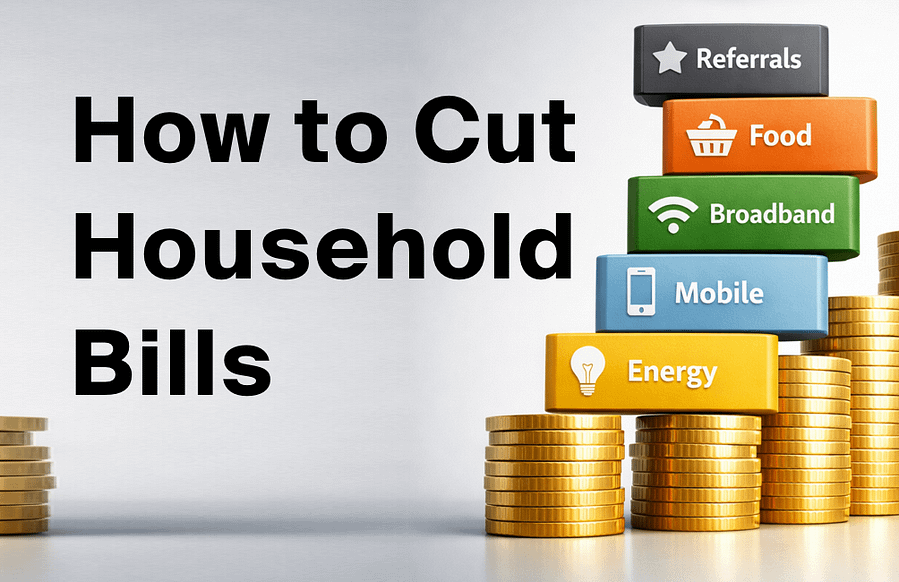
So how do you actually cut household bills in the UK without making your life miserable? This guide covers seven realistic ways to reduce what you pay each month across energy, your mortgage, food shopping, broadband, mobile and more. Every suggestion links to a deeper guide or a tried-and-tested deal on this site, so you can act on each one straight away.
Why April 2026 is a good time to review your bills
Three big changes land in April 2026. First, the Ofgem energy price cap drops to £1,641 a year for a typical dual-fuel household paying by direct debit, a fall of £117 compared with the January–March quarter. Second, council tax is going up by at least 5% in most areas. Third, broadband and mobile providers are applying their annual price rises.
The net effect for most households is mixed. You will pay slightly less for energy but more for council tax, broadband and water. As a result, this is the ideal moment to review every line on your monthly outgoings and claw back what you can. Here is where to start.
1. Switch your energy supplier (and get £50 free)
Around 60% of UK households sit on a standard variable tariff, which means they pay whatever the price cap allows. That is £1,641 a year from April. However, fixed deals from competitive suppliers can beat the cap, sometimes significantly.
Octopus Energy consistently ranks among the cheapest and best-rated suppliers in the UK. Their flexible tariff typically tracks close to or below the cap, and they offer smart tariffs that can go even lower if you shift usage to off-peak hours. Switching takes about five minutes online and Ofgem's faster-switching rules mean you will be on supply within five working days.
Use a referral link when you sign up and you will get £50 credited to your account once your first direct debit clears. That is essentially a free month of gas. For a full breakdown of how the scheme works and what to watch out for, see our guide to the Octopus referral scheme.
Related reading: Ofgem price cap 2026 explained | Can you leave Octopus anytime? | Is Octopus worth switching to?
2. Overpay your mortgage (even a little helps)
Your mortgage is almost certainly your biggest monthly outgoing. Even small overpayments can save you thousands in interest over the life of the loan. For example, overpaying by just £100 a month on a £200,000 mortgage at 4.5% could save you over £20,000 in interest and shorten your term by several years.
Most lenders allow you to overpay up to 10% of your outstanding balance each year without penalty. The challenge is remembering to do it. That is where Sprive comes in. The app connects to your mortgage account, rounds up your spending and makes automatic overpayments on your behalf. It also offers cashback on gift card purchases through its in-app marketplace, which gets redirected towards your mortgage.
We have a full breakdown of how Sprive works, plus a Sprive referral code if you want to try it.
Your home may be repossessed if you do not keep up repayments on your mortgage.
Related reading: Mortgage overpayment UK guide | Sprive overpayment rules | How to pay off your mortgage faster
3. Cut your food bill with a meal kit
The average UK household spends roughly £3,900 a year on groceries. A decent chunk of that goes on food waste: ingredients bought with good intentions that end up in the bin. Meal kits solve this by sending you exactly what you need for each recipe, pre-portioned and ready to cook.
Grubby is the UK's first fully vegan meal kit service. Prices start from around £4–7 per serving depending on box size, recipes take about 25–30 minutes, and everything is plant-based by default. They also donate a meal to a child in need for every box sold and hold B Corp certification.
Even if you are not vegan, swapping two or three meat-heavy dinners a week for plant-based alternatives can noticeably reduce your food spend. Meat and dairy are consistently the most expensive items on a typical grocery receipt.
New customers can get a discount on their first box. Check the latest Grubby discount code for the current offer.
Related reading: Best vegan meal kits UK | Is Grubby worth it?
4. Switch your broadband
Most broadband contracts run for 18–24 months. When they end, you are quietly moved onto a rolling deal at a higher price. This is one of the easiest wins on this list: check when your contract ends and switch before the next billing cycle.
OneStream is one of the cheapest broadband providers in the UK. Their Fibre 40 plan (38Mbps average, unlimited data) starts from £16.99 a month on a 24-month contract, with no mid-contract price rises. That is comfortably below the UK average of around £36 a month. For most households that mainly stream video, browse and work from home, 38Mbps is more than enough.
If you need faster speeds, OneStream also offers full fibre packages up to 945Mbps. Additionally, if you are in a full fibre area, BeFibre is worth comparing too.
See our OneStream referral code for a sign-up bonus.
5. Drop your mobile bill
If you are paying more than £10 a month for mobile, you are almost certainly overpaying. The big networks (EE, Vodafone, Three) charge a premium for the same infrastructure that smaller providers use at a fraction of the cost.
Honest Mobile runs on EE's network and starts from £6 a month for 3GB. Smarty uses Three's network with plans from £6 a month for 12GB. giffgaff runs on O2 from £8 a month. All three offer rolling monthly contracts, 5G access and eSIM support.
Switching takes minutes and you keep your number. For a full comparison, read our best SIM only deals UK 2026 guide.
If you use a referral link for Honest Mobile, you will also get a month free. See our Honest Mobile referral code.
6. Use referral bonuses to offset costs
This one sounds small, but it compounds quickly. Most of the services mentioned in this guide offer referral bonuses when you sign up through an existing customer's link: £50 from Octopus, a discount from Grubby, £20 from OneStream, a free month from Honest Mobile. Stack those up and you are looking at over £100 in free credits before you have changed a single habit.
We maintain a regularly updated list of every working UK referral offer we have tested. See our best referral offers UK 2026 roundup for the full list.
7. Review your subscriptions and insurance
The average UK adult now spends over £40 a month on subscriptions they do not fully use. Streaming services, gym memberships, app trials that quietly converted to paid plans. Go through your bank statement line by line and cancel anything you have not used in the last 30 days.
For pet insurance specifically, it is worth comparing annually rather than auto-renewing. Providers like ManyPets and Waggel often undercut legacy insurers, especially for younger pets. For home insurance, Urban Jungle is designed for renters and younger homeowners.
How much could you save if you cut household bills in the UK?
Here is a rough breakdown of what switching across these categories could save a typical household each year:
| Category | Typical saving |
|---|---|
| Energy (switch + referral) | £50–200/year |
| Mortgage overpayments | Thousands over the term |
| Food (2–3 plant-based swaps/week) | £300–600/year |
| Broadband (switch to OneStream) | £200–300/year |
| Mobile (switch to Smarty/Honest/giffgaff) | £120–300/year |
| Referral bonuses (stacked) | £100–150 one-off |
| Subscriptions audit | £200–500/year |
Altogether, a realistic total saving sits between £1,000 and £2,000+ a year. None of these require extreme lifestyle changes. Most take less than ten minutes to set up. The biggest gains come from energy and broadband switching, because those are the categories where loyalty is penalised most.
Source: Ofgem price cap data (February 2026), ONS Family Spending Survey, provider pricing checked March 2026. Savings estimates are illustrative and depend on your current deals and usage.
Frequently asked questions
What is the biggest household bill in the UK?
For most homeowners, the mortgage is the single largest monthly outgoing. For renters, it is rent. After housing costs, energy is typically the next biggest bill, followed by council tax, food and transport. The Ofgem price cap sets the maximum a supplier can charge per unit on standard variable tariffs, but your actual bill depends on how much energy you use.
How much can I save by switching energy supplier?
It depends on your current tariff. If you are on a standard variable tariff at the cap rate (£1,641/year from April 2026), switching to a competitive fixed deal could save £50–150 a year. On top of that, using a referral link when joining Octopus Energy gives you £50 in account credit, which is applied after your first direct debit.
Is it worth overpaying my mortgage?
In most cases, yes, provided you have cleared any higher-interest debt first and have an emergency fund. The interest saved on mortgage overpayments is effectively a tax-free return at your mortgage rate. Most lenders allow up to 10% overpayment each year without early repayment charges. See our overpay mortgage or invest guide for a detailed comparison.
Are vegan meal kits actually cheaper than regular cooking?
Per serving, meal kits like Grubby (£4–7 per portion) cost about the same as a mid-range supermarket shop once you factor in reduced food waste. The real saving is indirect: you buy exactly what you need, waste less, and plant-based proteins (lentils, chickpeas, tofu) are consistently cheaper than meat.
When should I switch broadband?
Ideally, 30 days before your current contract ends. Most providers auto-renew you onto a more expensive rolling deal if you do not actively switch or renegotiate. Set a calendar reminder for a month before your contract expiry date.
Do referral bonuses actually work?
Yes, provided you follow the sign-up process correctly. The key rule is to use the referral link directly rather than going through a comparison site, which usually breaks the tracking. We test every referral offer listed on CoolCuration before publishing it. See our best referral offers UK 2026 page for what is currently live.
More from CoolCuration
- Winter energy saving tips — simple ways to cut your heating bills and stay warm all season.
- TopCashback referral code — earn cashback on everyday purchases and stack it with other savings.
- Phox water filter — ditch bottled water and save money at the same time.
- Gifts that give back — curated picks that support good causes without breaking the bank.
- Emma app — track your spending and spot where your money goes each month.
This article contains affiliate links. CoolCuration may earn a commission if you sign up through a referral link, at no extra cost to you. This helps keep the site running and free to use. All recommendations are editorially independent. This is not financial advice.
What's trending



Recent posts
- Structured App Review UK 2026: The Day Planner That Sticks
 Our first App of the Month. Structured turns your day into one visual timeline, it is free to start, and Apple made it a 2026 Design Award finalist for Inclusivity. Here is what it does brilliantly and where the paywall lands wrong. #StructuredApp #DailyPlanner #ProductivityApps #AppleDesignAwards #AppOfTheMonth
 - Monzo Perks and Max Price Increase 2026: Every New PriceMonzo Perks goes from £7 to £9 a month and Max from £17 to £19. Here are all the new plan prices, the dates that matter, and the honest maths.
- Which Supermarkets Does Sprive Support?Seven supermarkets. Seven rates. One catch: the cashback never reaches your bank account, it goes straight at your mortgage. Here's exactly what Sprive pays at Tesco, ASDA, M&S and the rest, taken from my own app rather than a press release.


No Comments.